Category: Uncategorized

  • Tankless Water Heater Repair North Georgia: Troubleshooting and Professional Fixes

    Tankless Water Heater Repair North Georgia: Troubleshooting and Professional Fixes

    Stepping into a warm shower only to get blasted by an icy shock midway through is the last thing any homeowner wants to face. Dealing with sudden temperature swings or staring at a cryptic digital error code is genuinely frustrating, especially when you worry that mineral scale has damaged your heat exchanger. When you need reliable tankless water heater repair North Georgia homeowners often wonder whether these unexpected failures mean a simple component fix or a complete system replacement.

    You shouldn’t have to guess why your system is acting up or endure cold showers while searching for answers. This guide breaks down the primary mechanical causes behind fluctuating temperatures, decodes common system alert codes, and explains how to evaluate your repair options clearly. We’ll also preview the thorough diagnostic approach used by Stuart The Plumber, a licensed local plumbing company serving Braselton and nearby North Georgia communities, to help you restore steady hot water without unnecessary disruption.

    Key Takeaways

    • Spot early warning signs like fluctuating water temperatures and rumbling sounds to address mineral buildup before it triggers a complete system shutdown.
    • Understand how critical components like flow sensors, ignition assemblies, and heat exchangers interact to prompt diagnostic safety codes.
    • Learn practical ways to evaluate your equipment’s age and overall condition so you can choose between a targeted repair and a full system replacement.
    • Discover what to expect during a diagnostic service visit when you need dependable tankless water heater repair North Georgia homes rely on for steady hot water.

    Common Signs Your North Georgia Tankless Water Heater Needs Immediate Repair

    Modern on-demand systems present distinct mechanical warning signs long before they suffer a total operational failure. Unlike conventional storage tanks that fail by leaking around rusted base pans, an on-demand unit alerts you through electronic sensor trips, fluctuating flow rates, and unusual combustion noises. Spotting these red flags early helps you arrange targeted tankless water heater repair North Georgia technicians can resolve before internal components face permanent stress.

    The Cold Water Sandwich and Temperature Fluctuations

    A momentary gap in hot water flow often creates the dreaded “cold water sandwich.” This happens when residual hot water exits your supply pipe, followed briefly by unheated water before the burner ignites again. While a brief delay is normal, frequent cycling points to a failing flow sensor switch or obstructed inlet filter. When scale chokes supply lines, restricted water volume triggers the unit’s high-limit safety switches, causing burner shutdowns during active showers. If you’re experiencing complete temperature loss, review our no hot water troubleshooting guide for Georgia homes for basic system checks.

    Digital Error Codes and System Lockouts

    Digital display interfaces provide real-time diagnostic telemetry, flashing alphanumeric codes when systems shut down. Common error codes highlight critical ignition lockouts, flame detection failures, or dangerous exhaust venting restrictions. Severe seasonal storms across North Georgia also trigger electrical line surges that scramble control board programming. Resetting your system might restore hot water temporarily, but repeatedly clearing lockout codes without addressing mechanical faults can burn out delicate printed circuit boards.

    Mineral Scaling and Hard Water Strain

    According to technical overviews of Tankless water heating engineering, continuous thermal transfer requires unobstructed internal fluid dynamics. Ground minerals bake directly onto intense heat exchanger surfaces during operation, creating thick calcium deposits that cut heat transfer efficiency and drop household water pressure. Overheating scale layers generate clicking or rumbling sounds inside the cabinet. If severe scale or line clogs cause backed-up drainage lines, pairing service with professional drain line repair keeps connected discharge pathways open and safe.

    Key Mechanical Components That Fail in On-Demand Water Heaters

    An on-demand water heater houses tightly synchronized water, electrical, and gas combustion assemblies inside a compact cabinet. Because modern units prioritize household safety, a fault in even one minor sensor triggers an immediate shutdown. When you need specialized tankless water heater repair North Georgia plumbing professionals test each circuit, valve, and probe individually to pinpoint the breakdown rather than swapping random parts.

    Heat Exchanger Corrosion and Thermal Cracking

    Rapid thermal cycling causes copper and stainless steel heating tubes to expand and contract repeatedly. Over time, that physical stress creates microscopic stress fractures. In high-efficiency condensing models, acidic moisture from exhaust gases can pool if drain traps clog, corroding external casing metals and piping joints. When visible moisture appears beneath the cabinet, knowing who to call for a leaking water heater helps prevent structural water damage to surrounding walls and flooring.

    Ignition Systems and Flame Sensor Malfunctions

    Gas-fired tankless units rely on delicate spark igniters and flame rectification rods. Microscopic carbon deposits gradually coat the metal probe, insulating it from the burner flame. When the control board cannot verify active combustion, it closes the gas solenoid valve to prevent raw gas leaks. Electric igniters can also wear down over time, causing repeated ignition failures. If your unit clicks repeatedly without lighting, you can reach out to our local team for accurate electrical component testing.

    Venting Blockages and Combustion Air Intake

    Proper airflow is just as vital as clean water delivery. Outdoor debris, leaves, and insect nests frequently obstruct concentric PVC and polypropylene intake pipes across North Georgia properties. Without adequate air intake, the burner starves of oxygen, causing incomplete fuel combustion and tripping internal draft sensors. A failing variable-speed exhaust blower fan can also drop air pressure, triggering sudden safety lockouts during hot water demand.

    Tankless Repair vs. Replacement: Making the Right Decision for Your Home

    Deciding between fixing a malfunctioning unit or replacing it outright comes down to age, service history, and component availability. While a conventional storage tank rarely lasts past a decade, on-demand hardware offers much greater durability when properly maintained. When weighing options for tankless water heater repair North Georgia homeowners should evaluate whether a targeted fix preserves an otherwise healthy appliance or merely delays an inevitable replacement.

    Evaluating Unit Age and Component Longevity

    Tankless water heaters deliver an expected lifespan of 15 to 20 years, roughly double the service life of standard 8-to-12-year storage tanks. If your on-demand system is under ten years old, replacing individual wear items like water valves, igniters, or sensors is usually the smartest path forward. Routine annual flushes protect those internal parts, keeping the system operating near peak efficiency across its full operational life.

    Repair Costs vs. Upgrading to Modern High-Efficiency Units

    A practical rule of thumb is to consider a new system if a major repair approaches half the cost of replacement hardware. When a primary heat exchanger fails on an older, non-condensing system, upgrading to a condensing model often proves more economical. Modern condensing units capture thermal energy from exhaust gases to achieve efficiency ratings exceeding 95%. Homeowners considering an upgrade can consult our Braselton water heater installation 2026 buying guide to assess high-efficiency configurations and regional code standards.

    Preventative Descaling and Maintenance Requirements

    Preventative care dramatically reduces the frequency of emergency calls. Professional descaling involves circulating a food-grade solution through service isolation valves using a specialized submersible pump to dissolve hardened calcium bonds. Technicians also remove and rinse the cold-water inlet filter screen to stop trapped sediment from starving water flow. Scheduling annual chemical flushes directly protects the heat exchanger and preserves active manufacturer warranties. Ensuring proper condensation runoff into your household plumbing or scheduling targeted drain line repair prevents acidic drainage backup from corroding nearby utility surfaces.

    Tankless Water Heater Repair North Georgia: Troubleshooting and Professional Fixes

    What to Expect During a Professional Tankless Water Heater Repair Service

    Professional service begins with safety isolation before anyone loosens a single screw. Technicians shut off incoming water valves, isolate fuel supplies, and disconnect high-voltage electrical breakers. When scheduling comprehensive tankless water heater repair North Georgia homeowners should expect methodical diagnostics rather than fast guesswork. Field specialists systematically inspect the burner box, check mechanical intake blowers, and verify water turbine movement to diagnose root causes accurately.

    On-Site Diagnostic Testing and Safety Verification

    Accurate troubleshooting relies on specialized testing equipment. Plumbers connect digital manometers to verify static and dynamic gas supply pressures under full operating load. They use digital multimeters to measure electrical resistance across thermostats, flame sensors, and printed circuit board pathways. Technicians also confirm that acidic moisture routes freely through condensation drains without backing up into combustion chambers.

    Component Replacement and System Recalibration

    Once diagnostic testing identifies the failed part, the replacement process follows strict manufacturer specifications:

    • Precision installation: Faulty parts like flow meters, solenoid valves, or control modules are swapped with certified replacements designed for your specific brand.
    • Fuel-air balancing: Burner assemblies are calibrated to ensure clean combustion and proper exhaust temperatures.
    • Joint and pressure testing: Plumbers complete soap-bubble gas checks and high-pressure water leak tests across all unions before restoring active utility lines.

    Partnering with Stuart The Plumber for Reliable Hot Water

    Stuart The Plumber serves Braselton and neighboring North Georgia communities with honest, skilled water heater service. We prioritize thorough diagnostics to repair your working equipment whenever practical, recommending system replacement only when extensive damage makes repairs unwise. If your on-demand system locks out or stops heating, schedule an on-site evaluation with Stuart The Plumber to get your home’s hot water flowing reliably again.

    Restore Reliable Hot Water to Your Home

    You shouldn’t have to tolerate cold showers or spend hours deciphering system error codes. Addressing early warning signs like flow fluctuations and mineral accumulation protects your equipment against premature failure. When an on-demand unit acts up, obtaining dependable tankless water heater repair North Georgia homeowners trust ensures pinpoint diagnostic testing and lasting mechanical resolutions.

    Stuart The Plumber delivers honest, licensed plumbing expertise to families throughout Braselton, Hoschton, Buford, and nearby communities. From targeted sensor replacements to preventative descaling and waterline care, our team focuses on finding the right fix for your specific system. Getting your hot water running smoothly again is just a phone call away.

    Take control of your home comfort today and let our local plumbing team handle the rest with care and precision.

    Frequently Asked Questions

    Why is my tankless water heater blowing cold water after running hot?

    This issue usually happens because of a sudden drop in water flow, a sticking flow sensor, or an overheating heat exchanger tripping internal safety switches. If water usage dips below your unit’s minimum activation flow rate, the burner shuts off immediately. Mineral scaling can also trap excessive heat inside the exchanger, prompting the high-limit thermostat to kill power and deliver an unexpected burst of cold water.

    Can hard water ruin a tankless water heater in North Georgia?

    Yes, dissolved calcium and magnesium bake directly onto internal heating chambers during rapid thermal transfer. Over time, this calcified layer restricts water flow and insulates critical temperature sensors. Without regular maintenance, severe scale creates localized hot spots across the copper or stainless tubing, causing metal fatigue, thermal stress fractures, and leaks that require professional tankless water heater repair North Georgia homeowners want to prevent.

    What do the error codes on my tankless water heater mean?

    Error codes are diagnostic signals generated by the internal computer board to pinpoint specific system faults. These alphanumeric indicators highlight issues like unstable gas pressure, blocked intake venting, failed electronic ignition, or severe scale buildup. Rather than guessing why your unit locked out, checking your manufacturer manual or contacting a licensed technician ensures the code translates into a precise, targeted mechanical repair.

    How often should a tankless water heater be flushed and serviced?

    Most manufacturers recommend flushing and servicing an on-demand system once every 12 months. Annual descaling with an approved solution dissolves stubborn mineral buildup inside heat exchanger passages before water flow is choked. Routine maintenance visits also include cleaning out the cold-water inlet filter screen, inspecting electrical connections, and verifying clean burner combustion to ensure dependable performance throughout the year.

    Is it better to repair or replace an aging tankless water heater?

    Repair is usually the best choice for units under 10 years old that have received regular maintenance and only need replacement parts like sensors, valves, or igniters. If your unit is approaching 15 to 20 years old or has a cracked, leaking heat exchanger, replacement is often the more sensible investment. A qualified technician evaluates overall equipment wear and component availability before advising on the smartest path forward.

    Can any licensed plumber repair my specific brand of tankless heater?

    While any licensed plumber understands household piping, modern on-demand units require specialized knowledge of digital control boards, combustion calibration, and advanced error diagnostics. When arranging tankless water heater repair North Georgia property owners should choose plumbers trained in electronic troubleshooting. Stuart The Plumber services major gas and electric tankless brands across Braselton and surrounding communities, resolving complex mechanical and venting issues safely.

    Stuart Balestracci

    Article by

    Stuart Balestracci

    Stuart is a third-generation master plumber dedicated to providing dependable, honest plumbing service throughout Braselton and North Georgia. Building on a family tradition of hands-on trade expertise, he brings practical problem-solving and high standards to every job—from urgent leaks and clogged drains to water heaters, sewer lines, and whole-home repiping.

    Stuart believes customers deserve clear answers, quality workmanship, and repairs that address the real issue—not a quick fix that creates another problem later. Through Stuart the Plumber, LLC, he serves homeowners, property managers, and businesses with professional service, straightforward communication, and respect for their property. The company operates as a licensed Georgia plumbing business, license MP208668.

    Disclaimer

    The information in this article is provided for general educational and informational purposes only. While Sturat the Plumber, LLC makes reasonable efforts to keep information accurate and current, plumbing conditions, building systems, local codes, manufacturer instructions, and repair requirements vary by property and may change over time.

    This content is not a substitute for an on-site inspection, diagnosis, estimate, professional plumbing service, or advice from a properly licensed professional. Do not rely on this article to diagnose gas leaks, sewer backups, hidden water leaks, water-heater failures, burst pipes, or other potentially hazardous conditions.

    Plumbing work can involve risks including water damage, electrical hazards, gas hazards, sewage exposure, structural damage, and personal injury. Always follow applicable local codes, product instructions, and safety requirements. For active leaks, suspected gas leaks, sewage backups, flooding, loss of water service, or any situation that may create an immediate safety risk, contact a qualified professional or emergency services as appropriate.

    Sturat the Plumber, LLC does not guarantee that the information in this article is complete, suitable for every property, or applicable to your specific circumstances. Any decisions or actions taken based on this content are at your own risk. Sturat the Plumber, LLC disclaims liability for loss, damage, injury, expense, or other consequences arising from the use of or reliance on this information.

    For an evaluation of your specific plumbing concern, contact Sturat the Plumber, LLC for professional service. Sturat the Plumber, LLC is a licensed Georgia plumbing business, license MP208668.

  • Sewer Drain Cleaning Georgia: The Homeowner’s Guide to Main Line Care

    Sewer Drain Cleaning Georgia: The Homeowner’s Guide to Main Line Care

    You run your washing machine, and moments later, foul-smelling water bubbles up into your downstairs bathtub. When multiple fixtures back up simultaneously, a hand plunger won’t fix the issue. You are facing an underground blockage that calls for professional sewer drain cleaning Georgia homeowners can depend on.

    It’s an unnerving situation. Lingering sewer smells, gurgling toilets, and the anxiety of potential water damage can quickly leave you feeling overwhelmed, especially when you aren’t sure whether your system needs basic mechanical snaking or heavy-duty hydro jetting.

    You don’t have to face this blindly. In this guide, you’ll learn how to identify, clear, and prevent main sewer line clogs using proven plumbing methods. We’ll explore why North Georgia’s shifting red clay and invasive tree roots trigger severe blockages, break down the differences between cable augers and high-pressure jetting, and show you when to call a licensed local team like Stuart The Plumber to restore your lines.

    Key Takeaways

    • Learn how to tell the difference between an isolated sink blockage and a serious main sewer backup before wastewater damages your home.
    • Understand how North Georgia’s expansive red clay soil and native tree roots create continuous structural stress on underground sewer laterals.
    • Discover when mechanical snaking provides a temporary opening versus when hydro jetting delivers the comprehensive sewer drain cleaning Georgia properties need for long-term flow.
    • Find out why licensed plumbers use high-definition camera inspections to assess pipe integrity before clearing lines and to protect your yard from unnecessary digging.
    • Identify everyday drain care habits that help stop recurring backups and know the right time to call a trusted local plumber for service.

    Recognizing Main Sewer Drain Clogs in Georgia Homes

    A single slow sink is an inconvenience. A clogged main sewer line is an immediate property emergency. When the central lateral line connecting your house to the municipal system stops moving, waste water has nowhere to escape. It backs up into your living spaces through the lowest plumbing fixtures. Recognizing these warning signs early keeps contaminated water from ruining your flooring, subflooring, or basement.

    Many homeowners reach for store-bought chemical drain cleaners at the first sign of trouble. Don’t make this mistake. Chemical cleaners sit in standing wastewater, generating caustic heat that eats through older cast-iron and PVC joints without dissolving heavy underground obstructions. When you face widespread drainage failures, you need professional diagnostic methods and proper sewer drain cleaning Georgia plumbers use to solve the root problem safely.

    Telltale Signs of a Main Sewer Line Blockage

    Main sewer issues show up across multiple rooms at the same time. Keep an eye out for these critical red flags:

    • Simultaneous backups: Flushing an upstairs toilet causes water to surge into a downstairs shower pan or floor drain.
    • Gurgling and bubbling: Trapped sewer gas forces air backward through fixture traps when you run your washing machine or dishwasher.
    • Standing water at lowest levels: Basements, slab-level bathrooms, and crawlspace drains show dirty water first because gravity pulls wastewater to the lowest point.
    • Persistent sewer odors: Unpleasant hydrogen sulfide smells waft from indoor drains or around outdoor cleanout caps, signaling stagnant waste trapped in the lateral.

    Branch Line Clogs vs. Main Sewer Obstructions

    Knowing whether you have a branch line problem or a main line stoppage determines your next step. Branch lines serve single fixtures. If your master bathroom sink drains slowly while the adjacent shower and toilet run freely, the clog is confined to that individual P-trap arm. Review our guide on clogged drains in North Georgia to troubleshoot isolated branch line issues.

    Main sewer obstructions shut down your home’s entire drainage perimeter. If running water anywhere in the building causes backups elsewhere, hydrostatic backpressure is building inside your main lateral pipe. Stop running all water immediately and call Stuart The Plumber to prevent blackwater overflows.

    Why Georgia Sewer Lines Clog: Red Clay, Roots, and Pipe Aging

    Subterranean plumbing in North Georgia operates under continuous environmental pressure. The ground beneath our homes isn’t static loam; it’s dense, highly reactive red clay. Understanding how regional soil and local plant life stress underground infrastructure is essential when selecting the right sewer drain cleaning Georgia homeowners need for lasting relief.

    North Georgia Red Clay Dynamics and Pipe Movement

    Georgia red clay undergoes an intense shrink-swell cycle. During heavy seasonal downpours, saturated clay expands forcefully, exerting lateral and upward pressure on buried lines. In dry summer months, the clay shrinks and settles. This ground movement pulls pipe joints apart and creates low spots known as “bellies.” Even a slight joint offset creates an internal ledge where toilet paper and waste catch instead of washing away.

    Invasive Tree Roots Seeking Drain Moisture

    Native trees like loblolly pines, water oaks, and sweetgums develop extensive root systems built to hunt for water. According to regional data from JMJ Plumbing, root intrusion accounts for roughly 60% of main sewer line blockages in established neighborhoods with mature landscaping. Hair-thin root fibers slip into hairline joint cracks to feed on passing moisture. Inside the warm pipe, they bloom into thick, fibrous nets that catch debris and cause full blockages.

    Corrosion, Scale, and Fat Buildup Inside Lines

    Decades of mineral contact cause older cast iron pipes to develop jagged rust scale along their bottom channels. When kitchen grease and bathroom fats enter the system, they solidify against these rough surfaces. Even modern bathroom wipes catch on internal scale, accumulating layer by layer until wastewater halts completely.

    If your system shows signs of chronic backups or sluggish flow, you can reach out to our local team to inspect your lateral line before hidden joint offsets turn into complete pipe failures.

    Professional Sewer Cleaning Methods: Snaking vs. Hydro Jetting

    Clearing an underground stoppage requires matched tooling. Poking blindly through a clogged lateral can crack old pipe walls or leave severe blockages mostly intact. Modern sewer drain cleaning Georgia plumbing professionals perform relies on two primary physical methods: mechanical snaking and hydraulic scouring. Choosing the right tool depends entirely on what sits inside the line.

    Mechanical Drain Snaking and Augers

    Mechanical snaking relies on heavy, rotating steel cables tipped with specialized cutting blades. The cable powers down the cleanout to punch through hard blockages, puncture dense root balls, or retrieve foreign objects like flushable wipes. Snaking is exceptional for providing immediate relief during an urgent backup, restoring basic drainage flow fast. However, mechanical blades only carve a narrow opening matching the blade diameter. They leave soft grease, mineral sludge, and perimeter root stubs clinging tightly to pipe walls, meaning recurring stoppages often return within months.

    High-Pressure Sewer Hydro Jetting

    Hydro jetting offers a permanent cleaning solution rather than a temporary puncture. Operating at water pressures between 1,500 and 4,000 PSI, this equipment drives self-propelling nozzles down the pipe. Forward-facing water jets break up stubborn clogs, while 360-degree reverse jets scour the inner circumference completely clean. Jetting washes away sludge, shears roots flush with the pipe joints, and restores the pipe to its original interior diameter. Explore our dedicated sewer jetting service in Georgia for comprehensive line restoration.

    Video Camera Inspection Diagnostics

    According to regional data from JMJ Plumbing, more than 60% of recurring sewer clog calls now incorporate fiber-optic camera diagnostics. Pushing a high-resolution, waterproof camera through the line takes the guesswork out of the job. Technicians inspect the pipe interior in real time, identifying whether an obstruction stems from root intrusion, heavy grease, or physical structural collapse. Running a camera before hydro jetting protects older, brittle clay or corroded cast-iron pipes from high-pressure water damage. When inspections reveal crushed or severely broken lines, homeowners can opt for modern trenchless sewer repair in North Georgia instead of disruptive landscape excavation.

    Sewer Drain Cleaning Georgia: The Homeowner's Guide to Main Line Care

    Preventing Sewer Backups and When to Call a Georgia Plumber

    Most residential main line emergencies build up quietly over months before surfacing. While regional soil shifts and searching tree roots happen out of sight, everyday household habits determine how quickly debris catches inside those vulnerable zones. Taking proactive control of your drains keeps waste flowing freely toward the street and stops dangerous blackwater from contaminating your living spaces.

    Routine line care protects both your indoor plumbing and your landscaping. When you combine sensible disposal habits with timely sewer drain cleaning Georgia homeowners can avoid emergency excavation and messy fixture overflows entirely.

    Homeowner Maintenance and Disposal Habits

    Keeping your main lateral clear starts with what you send down indoor drains. Implement these straightforward household rules:

    • Trash the grease: Pour leftover cooking oils, bacon grease, and buttery sauces into a heat-safe can to cool, then discard it in the trash. Never rinse fats down the sink.
    • Flush toilet paper only: Avoid flushing so-called “flushable” wipes, paper towels, facial tissues, feminine hygiene products, and dental floss. These items do not disintegrate and quickly snag on underground pipe joints.
    • Mind your landscaping: Map your sewer lateral path before planting new trees. Keep fast-growing species away from that underground corridor to minimize root migration toward pipe seams.
    • Maintain cleanout access: Locate the exterior PVC or cast-iron cleanout cap in your yard. Keep it free of thick mulch, gravel, and heavy lawn equipment so a technician can quickly access the main pipe without running heavy machinery through your hallways.

    When to Contact a Local Plumbing Professional

    Occasional slow drainage in a single sink is easy to manage, but whole-house drainage failure demands immediate attention. Call a licensed plumber the moment you notice water surfacing in a downstairs shower while your washing machine drains, or if multiple toilets bubble when flushed. Recurring monthly backups also signal an underlying structural defect, such as a ground-shifted pipe belly or broken joint, rather than a simple paper stoppage.

    For comprehensive underground diagnostics, learn about professional leak detection in Braselton, GA to identify hidden failures before minor cracks turn into costly washouts. Choosing Stuart The Plumber ensures honest evaluations and reliable sewer drain cleaning Georgia residents can trust across Braselton and surrounding North Georgia communities.

    Protect Your Property With Proactive Main Line Care

    A sluggish drain or recurring toilet bubble isn’t just an annoyance; it is an early warning from your underground plumbing. Between shifting red clay and aggressive native tree roots, North Georgia sewer lines endure continuous stress. Taking action with camera diagnostics and high-pressure jetting scours away stubborn blockages and preserves your pipe walls before wastewater enters your living spaces.

    Stuart The Plumber delivers the dependable sewer drain cleaning Georgia homeowners count on. As a licensed local plumbing company serving Braselton and surrounding communities, our team uses high-resolution video camera inspections and hydro jetting equipment to clear lines accurately. We focus on honest local craftsmanship and practical solutions that keep your plumbing flowing smoothly.

    Don’t wait for standing wastewater to damage your floors or foundation. Reach out today to restore lasting drainage and protect your home.

    Frequently Asked Questions

    What are the first signs that my main sewer line is backing up?

    The earliest warning sign is water surfacing in low-level fixtures, such as downstairs bathtubs or basement drains, while another appliance is draining. You may also hear toilets gurgling when your washing machine discharges or notice foul sewer gas odors coming from floor drains. Because a main line blockage traps wastewater across your entire home, simultaneous drainage trouble indicates an urgent issue in your central lateral line.

    Can tree roots be permanently cleared out of a sewer pipe?

    Mechanical augers and hydro jetters cut away invasive tree roots inside the pipe, but they do not seal the entry points. As long as cracks or separated joints remain exposed to North Georgia soil, nearby roots will continue growing back toward the moisture source. Achieving permanent relief requires repairing or lining the damaged section through trenchless restoration to seal off joint seams and prevent future root penetration.

    What is the difference between drain snaking and sewer hydro jetting?

    Snaking uses a flexible steel cable to punch a relief hole through dense clogs, restoring basic flow during an emergency. Hydro jetting uses water streams pressurized up to 4,000 PSI to scrub grease, sludge, and tree roots off the entire pipe circumference. For thorough sewer drain cleaning Georgia homeowners rely on hydro jetting to restore pipes to their original internal diameter rather than simply poking a temporary hole.

    Will chemical drain cleaners clear a clogged main sewer line?

    Store-bought chemical drain cleaners cannot clear a main sewer line blockage. Because main lines are long and buried deep underground, the chemicals become heavily diluted in standing water before reaching the obstruction. Worse, the caustic chemical reaction generates intense heat inside stagnant pipes, which can corrode older cast-iron walls, soften PVC glue, and damage pipe joints without dissolving heavy root masses or thick grease layers.

    How do plumbers locate the exact point of a sewer line blockage?

    Licensed plumbers feed a specialized fiber-optic camera through your exterior cleanout into the lateral line. As the camera travels underground, a technician watches real-time video footage to spot root masses, bellies, or joint misalignments. The camera head features a built-in radio transmitter, allowing the plumber to use an above-ground locator wand to mark the exact surface location and depth of the obstruction on your lawn without digging.

    How often should Georgia homeowners have their main sewer line cleaned?

    Most residential properties benefit from preventative line maintenance every 18 to 24 months. If your yard features mature pines or oaks close to the lateral line, scheduling regular sewer drain cleaning Georgia maintenance prevents thin root tendrils from expanding into severe blockages. Older homes in Braselton and surrounding areas with original cast-iron or clay pipes often need more frequent checks to manage rust scale and shifting red clay.

    Stuart Balestracci

    Article by

    Stuart Balestracci

    Stuart is a third-generation master plumber dedicated to providing dependable, honest plumbing service throughout Braselton and North Georgia. Building on a family tradition of hands-on trade expertise, he brings practical problem-solving and high standards to every job—from urgent leaks and clogged drains to water heaters, sewer lines, and whole-home repiping.

    Stuart believes customers deserve clear answers, quality workmanship, and repairs that address the real issue—not a quick fix that creates another problem later. Through Stuart the Plumber, LLC, he serves homeowners, property managers, and businesses with professional service, straightforward communication, and respect for their property. The company operates as a licensed Georgia plumbing business, license MP208668.

    Disclaimer

    The information in this article is provided for general educational and informational purposes only. While Sturat the Plumber, LLC makes reasonable efforts to keep information accurate and current, plumbing conditions, building systems, local codes, manufacturer instructions, and repair requirements vary by property and may change over time.

    This content is not a substitute for an on-site inspection, diagnosis, estimate, professional plumbing service, or advice from a properly licensed professional. Do not rely on this article to diagnose gas leaks, sewer backups, hidden water leaks, water-heater failures, burst pipes, or other potentially hazardous conditions.

    Plumbing work can involve risks including water damage, electrical hazards, gas hazards, sewage exposure, structural damage, and personal injury. Always follow applicable local codes, product instructions, and safety requirements. For active leaks, suspected gas leaks, sewage backups, flooding, loss of water service, or any situation that may create an immediate safety risk, contact a qualified professional or emergency services as appropriate.

    Sturat the Plumber, LLC does not guarantee that the information in this article is complete, suitable for every property, or applicable to your specific circumstances. Any decisions or actions taken based on this content are at your own risk. Sturat the Plumber, LLC disclaims liability for loss, damage, injury, expense, or other consequences arising from the use of or reliance on this information.

    For an evaluation of your specific plumbing concern, contact Sturat the Plumber, LLC for professional service. Sturat the Plumber, LLC is a licensed Georgia plumbing business, license MP208668.
  • Polybutylene Pipe Replacement in Georgia: 2026 Guide

    Polybutylene Pipe Replacement in Georgia: 2026 Guide

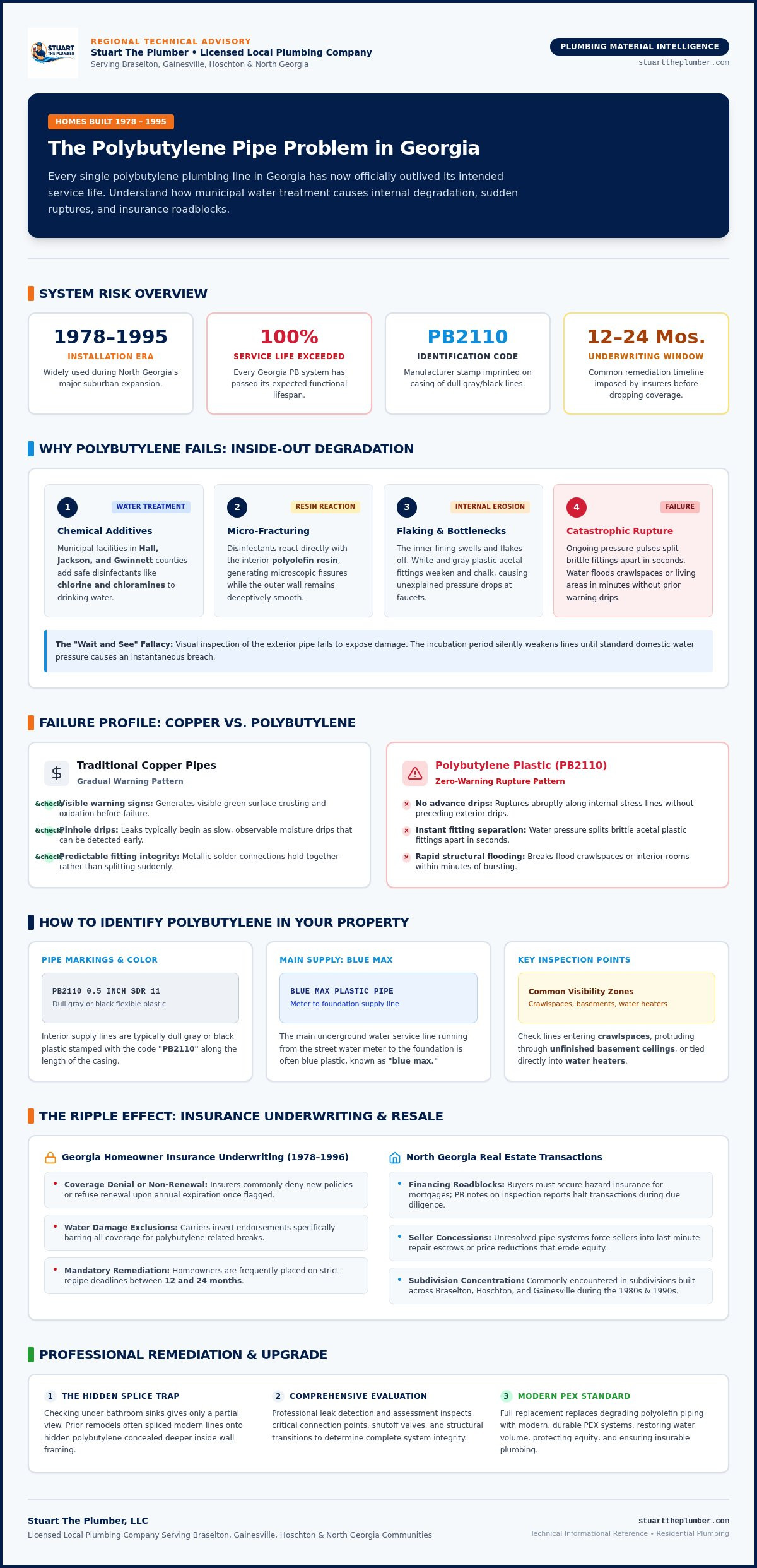
    Every single polybutylene pipe system in Georgia has now outlived its intended service life. If your home was built between 1978 and 1995, those dull gray lines behind your walls aren’t something you can safely ignore. Scheduling a polybutylene pipe replacement Georgia homeowners can rely on is no longer a matter of if, but when.

    It’s completely normal to feel uneasy about the risks. Nobody wants to deal with catastrophic leaks while away from home, unexpected insurance policy cancellations, or drops in resale value during a future home sale. You deserve dependable plumbing that protects your equity instead of keeping you on edge.

    This guide explains why polybutylene pipes fail in Georgia homes and how a professional replacement protects your property value and daily peace of mind. As a licensed local plumbing company serving Braselton and North Georgia, Stuart the Plumber, LLC breaks down common warning signs, modern repiping options, and the installation timeline so you know what to expect.

    Key Takeaways

    • Discover why standard municipal water additives cause gray plastic piping to deteriorate from the inside out.
    • Learn how to locate hidden polybutylene lines and spot physical warning signs around water heaters and crawlspaces.
    • Understand the step-by-step process of polybutylene pipe replacement Georgia homeowners use to upgrade to modern PEX.
    • Find out how proactive repiping helps prevent insurance coverage denials and preserves your property value.

    Understanding the Polybutylene Problem in Georgia Homes

    Polybutylene is a flexible, dull gray plastic pipe installed extensively in residential construction between 1978 and 1995. During North Georgia’s massive suburban expansion, builders favored this material because it was inexpensive and simple to rough in compared to rigid copper. Today, that short-term convenience creates serious liabilities for property owners. Scheduling a polybutylene pipe replacement Georgia specialists recommend is often the only permanent fix, because these lines fail from the inside out.

    A standard visual check will not tell you the whole story. The outer surface of the pipe can look completely smooth while the interior wall is flaking apart. That hidden degradation leaves homeowners unaware of the danger until a line suddenly lets go.

    The Role of Georgia Water Chemistry

    Municipal water treatment facilities across Hall, Jackson, and Gwinnett counties rely on chlorine and chloramines to keep drinking water safe. While harmless to drink, these disinfectants react directly with the polyolefin resin inside polybutylene. Over time, that chemical exposure creates microscopic fractures throughout the pipe walls and plastic fittings.

    As water pressure continuously pulses through the plumbing system, those micro-fractures spread. At Stuart the Plumber, LLC, our technicians regularly see these internal structural failures in subdivisions built across Braselton and Gainesville during the late 1980s and early 1990s.

    Why “Wait and See” is a Risky Strategy

    Pinhole leaks in copper lines typically give warning signs, such as green corrosion crust or slow, visible drips. Polybutylene behaves differently:

    • It ruptures along internal stress lines without dripping first.
    • Water pressure can split brittle fittings completely apart in seconds.
    • Unattended breaks can flood crawlspaces or finished living areas within minutes.

    The incubation period of polybutylene failure in Georgia climates is the multi-year chemical breakdown where treated water silently weakens the pipe until regular water pressure forces a sudden, catastrophic breach. Delaying your polybutylene pipe replacement Georgia project simply leaves your home vulnerable to sudden structural flooding when you least expect it. If a line does fail before you can schedule a replacement, having access to reliable emergency plumbing North Georgia homeowners can call immediately is critical to limiting water damage.

    Signs You Need Polybutylene Pipe Replacement

    Spotting trouble before a pipe bursts starts with knowing what materials sit behind your baseboards. Polybutylene interior lines are typically dull gray or black plastic, stamped with the code “PB2110” along the casing. You will most often spot them running into your crawlspace, sticking out from unfinished basement ceilings, or tied directly into your water heater connections. The main underground supply line running from your water meter out by the street to the foundation might also be blue plastic, known in the trade as “blue max.”

    Pay close attention to the fittings joining these pipes together. White or gray plastic acetal fittings often develop a chalky, flaking exterior as they break down. When water treatment chemicals weaken the plastic from within, the inner lining can swell and flake off. That internal bottleneck restricts water flow, causing unexplained pressure drops at your faucets. Worse, micro-fractures frequently create silent leaks inside stud bays, dripping into subfloors for months before peeling paint or musty odors expose the damage.

    Insurance and Resale Challenges in Georgia

    Carriers writing homeowners policies in Georgia maintain strict underwriting rules for properties built between 1978 and 1996. When underwriting inspections flag polybutylene, insurers commonly take one of three actions:

    • Deny new coverage or refuse to renew existing policies upon expiration.
    • Add specific water-damage exclusion endorsements that deny coverage for PB-related breaks.
    • Require homeowners to complete a repipe within a strict remediation window, often between 12 and 24 months.

    These policy restrictions directly affect home sales across Braselton and Hoschton. Buyers must secure hazard insurance to finalize mortgage financing. If a home inspector lists polybutylene, deals often stall during due diligence, forcing sellers into last-minute price concessions or repair escrows that hurt home equity.

    Visual Inspection vs. Professional Assessment

    Checking under a bathroom sink only gives you a tiny snapshot of your system. Many past remodels simply spliced modern materials onto hidden polybutylene lines deeper in the walls. Scheduling a professional leak detection can uncover active, hidden seepage before it destroys your flooring.

    During an on-site evaluation, a Stuart the Plumber, LLC technician examines connection points, shutoff valves, and structural transitions to determine the true state of your plumbing. If you suspect your lines are past their prime, you can reach out to our local team to review the best approach for a lasting polybutylene pipe replacement Georgia property owners can trust.

    The Replacement Process: What to Expect

    A full home repiping project sounds overwhelming, but an organized plan keeps the work running smoothly. The process breaks down into four practical stages:

    • Site assessment and mapping: Technicians survey the existing layout, locating all branch lines, main supply lines, and fixture connections throughout the structure.
    • Material selection: Modern flexible PEX piping is chosen for its longevity, thermal endurance, and resistance to municipal chlorine degradation.
    • Strategic access: Rather than tearing out entire walls, plumbers cut small, precision openings in drywall near fixture hookups to thread flexible lines through existing stud cavities.
    • Installation and testing: New lines are routed, secured, and pressure-tested before connecting to your fixtures, ensuring zero leaks prior to wall patching.

    Executing a proper polybutylene pipe replacement Georgia property owners can depend on means treating the home with care from start to finish.

    Trenchless Options for Service Lines

    Replacing the exterior polybutylene line that runs from the street meter to your foundation does not require destroying your front yard. With modern trenchless sewer and water line repair techniques, plumbers install durable new piping underground using minimal entry pits. This no-dig approach preserves mature Georgia landscaping, protects paved driveways, and completes exterior line work much faster than traditional open-trench digging.

    Minimizing Disruption in Your Daily Life

    Daily routines matter. Stuart The Plumber plans repipe work in organized zones, keeping your main water supply operational as long as possible each day. Service is usually shut off only during active line cutovers, with water restored by late afternoon whenever possible.

    Crews protect flooring with drop cloths, set up dust containment, and clean workspaces daily. For a standard North Georgia home, the plumbing installation typically takes between one and three days, followed by final county inspections and straightforward drywall restoration.

    Polybutylene Pipe Replacement in Georgia: 2026 Guide

    Investing in Your Home: ROI and Peace of Mind

    Replacing aging plumbing before it ruptures is one of the smartest investments a property owner can make. Emergency water extraction, structural drying, and mold remediation can quickly disrupt your life and generate huge out-of-pocket expenses, especially if an insurer denies the claim. A proactive upgrade eliminates that constant threat. Installing modern PEX tubing also delivers immediate daily improvements. PEX dampens the loud banging sounds caused by water hammer in older systems, and its smooth interior walls restore consistent water volume to your faucets and showers.

    Completing a professional repipe closes the loop with county inspectors and underwriters. Once the work receives final sign-off, you have the official documentation needed to satisfy insurance carriers and restore clean insurability to your title.

    Long-Term Durability of PEX vs. Polybutylene

    While polybutylene proved to be an unreliable experiment, PEX carries an expected design lifespan of up to 50 years. It handles North Georgia’s seasonal temperature swings with ease. Because flexible PEX tubing expands slightly under pressure changes, it provides superior resistance to splitting during harsh North Georgia winter freezes compared to rigid, embrittled plastic lines. In the event a freeze does cause a sudden pipe failure, knowing how to reach a trusted provider of emergency plumbing in North Georgia can make the difference between minor repairs and major structural damage.

    Choosing a Licensed Local Expert

    Repiping a residence involves pulling permits through county building offices in Jackson, Barrow, Hall, or Gwinnett. Working with a licensed Braselton plumber ensures every line meets the Georgia State Minimum Standard Plumbing Code. Local knowledge counts when navigating regional construction styles, crawlspace layouts, and utility connections.

    Scheduling a timely polybutylene pipe replacement Georgia homeowners can count on protects your equity before hidden leaks develop. Stuart The Plumber provides straightforward guidance and skilled craftsmanship to keep your water running safely. Protect your home and regain lasting peace of mind by getting in touch with our team today.

    Secure Your Georgia Home With Modern Piping

    Aging polybutylene plumbing puts your property at risk of sudden water damage, denied insurance claims, and complications during future resale. Proactive replacement solves these issues before a hidden line fails. Swapping fragile gray tubing for modern PEX restores reliable water pressure, eliminates pipe chatter, and provides dependable freeze resistance through cold Georgia winters.

    Stuart The Plumber is a licensed and insured local plumbing company serving Braselton and surrounding North Georgia communities. Our team specializes in repiping structures and trenchless utility line solutions, delivering careful craftsmanship with minimal disruption to your home. Taking control of your plumbing today ensures lasting protection for your investment and total peace of mind tomorrow.

    Scheduling a timely polybutylene pipe replacement Georgia experts recommend puts an end to plumbing worries and protects what matters most.

    Frequently Asked Questions

    How do I know if my Georgia home has polybutylene pipes?

    Inspect visible supply lines where water enters the house, such as around your water heater, basement ceilings, or crawlspace access points. Look for flexible, matte-gray tubing stamped with the code “PB2110” or blue plastic lines entering from the yard. If your property was built between 1978 and 1995 in communities like Braselton or Buford, having a licensed plumber confirm your pipe material removes the guesswork.

    Will my homeowners insurance cover a polybutylene pipe burst in 2026?

    Coverage depends entirely on your specific policy, but many Georgia carriers now restrict or completely exclude water damage caused by polybutylene failures. Insurers often add explicit exclusion endorsements or decline renewals once these pipes are flagged on an inspection report. Scheduling a proactive polybutylene pipe replacement Georgia plumbers perform is the safest way to prevent costly, uncovered restoration bills and maintain clean policy terms.

    How long does a full polybutylene pipe replacement take?

    The active plumbing installation typically takes one to three days for most single-family residences in North Georgia. Total time frames vary based on the square footage of your home, the number of bathrooms, and whether your house sits on a slab or crawlspace. Following the pipe installation, local county plumbing inspections and professional drywall patching usually take an additional day or two to wrap up completely.

    Do I have to move out of my house during the repiping process?

    No, you do not need to move out or book a hotel during the repiping process. Professional plumbing teams work in coordinated zones across your home to minimize daily disruption. Water service is shut off only during working hours while technicians install and tie in new lines. Crews make sure essential water service is restored by the end of each workday so your household remains functional overnight.

    What is the best material to replace polybutylene pipes with in Georgia?

    Cross-linked polyethylene, commonly known as PEX, is the preferred replacement material for Georgia residential plumbing systems. PEX is exceptionally durable, resists scaling and chlorine degradation from municipal water, and handles sudden regional freeze cycles better than rigid alternatives. Its flexibility allows plumbers to snake lines through existing wall framing with fewer fittings and significantly fewer drywall cuts than traditional copper pipe installations.

    Can I just replace the sections of pipe that are leaking?

    Spot repairs are not recommended because polybutylene breaks down uniformly throughout your entire plumbing system. Splicing a repair coupling onto a cracked line only shifts pressure to the next brittle section, practically guaranteeing another burst down the road. Investing in a comprehensive polybutylene pipe replacement Georgia specialists carry out permanently resolves the underlying risk, keeping your home dry and protecting your property value.

    Stuart Balestracci

    Article by

    Stuart Balestracci

    Stuart is a third-generation master plumber dedicated to providing dependable, honest plumbing service throughout Braselton and North Georgia. Building on a family tradition of hands-on trade expertise, he brings practical problem-solving and high standards to every job—from urgent leaks and clogged drains to water heaters, sewer lines, and whole-home repiping.

    Stuart believes customers deserve clear answers, quality workmanship, and repairs that address the real issue—not a quick fix that creates another problem later. Through Stuart the Plumber, LLC, he serves homeowners, property managers, and businesses with professional service, straightforward communication, and respect for their property. The company operates as a licensed Georgia plumbing business, license MP208668.

    Disclaimer

    The information in this article is provided for general educational and informational purposes only. While Sturat the Plumber, LLC makes reasonable efforts to keep information accurate and current, plumbing conditions, building systems, local codes, manufacturer instructions, and repair requirements vary by property and may change over time.

    This content is not a substitute for an on-site inspection, diagnosis, estimate, professional plumbing service, or advice from a properly licensed professional. Do not rely on this article to diagnose gas leaks, sewer backups, hidden water leaks, water-heater failures, burst pipes, or other potentially hazardous conditions.

    Plumbing work can involve risks including water damage, electrical hazards, gas hazards, sewage exposure, structural damage, and personal injury. Always follow applicable local codes, product instructions, and safety requirements. For active leaks, suspected gas leaks, sewage backups, flooding, loss of water service, or any situation that may create an immediate safety risk, contact a qualified professional or emergency services as appropriate.

    Sturat the Plumber, LLC does not guarantee that the information in this article is complete, suitable for every property, or applicable to your specific circumstances. Any decisions or actions taken based on this content are at your own risk. Sturat the Plumber, LLC disclaims liability for loss, damage, injury, expense, or other consequences arising from the use of or reliance on this information.

    For an evaluation of your specific plumbing concern, contact Sturat the Plumber, LLC for professional service. Sturat the Plumber, LLC is a licensed Georgia plumbing business, license MP208668.
  • No Hot Water? Troubleshooting Guide for Georgia Homes

    No Hot Water? Troubleshooting Guide for Georgia Homes

    You step into the shower on a crisp morning in Braselton, expecting a warm start to your day, only to be shocked by a stream of ice-cold water. It’s an immediate disruption that leaves you wondering if you’re facing a simple fix or a massive repair bill. At Stuart The Plumber, we know that losing hot water feels like a household emergency. You’re likely concerned about the safety of your gas or electrical connections and whether you need a professional no hot water plumber Georgia families can rely on for an honest diagnosis.

    We agree that nobody should have to endure cold showers or the stress of an undiagnosed plumbing failure. This guide will help you understand why your system stopped working and show you how to safely check for common issues like tripped breakers or extinguished pilot lights. We’ll walk through the most frequent causes of water heater failure in North Georgia, from sediment buildup to failing thermostats. You’ll learn exactly when a repair is possible and when the 2026 Georgia plumbing codes suggest it’s time to consider a more efficient replacement for your home.

    Key Takeaways

    • Perform safe, basic checks on your breaker panel or gas pilot light to see if your hot water loss is a simple fix you can handle yourself.
    • Identify the specific failure points for both tank and tankless systems, including how North Georgia’s water profile affects your unit’s lifespan.
    • Learn when it is time to call a licensed no hot water plumber Georgia residents rely on for hazardous repairs involving gas lines or high-voltage electrical components.
    • Recognize “red flag” symptoms, such as internal tank ruptures or persistent sediment issues, that signal your water heater needs professional intervention.
    • Evaluate the long-term benefits of repairing your current unit versus upgrading to a high-efficiency system that meets the latest energy standards.

    Initial Troubleshooting Checklist for Georgia Homeowners

    Before you search for a no hot water plumber Georgia families trust, you can perform a few safe, basic checks. Sometimes the loss of hot water is caused by a simple external factor rather than a mechanical failure inside the unit. Stuart The Plumber recommends starting with your home’s utility connections to rule out common power or fuel interruptions.

    Checking the Power and Gas Supply

    Electric water heaters are high-draw appliances that can occasionally trip a circuit breaker. Locate your electrical panel and look for a double-pole breaker labeled for the water heater. If it’s in the “off” or “neutral” position, flip it fully to off and then back to on. If the breaker trips again immediately, stop and call a professional; this often indicates a shorted heating element or a wiring issue.

    For gas units, verify that the gas shut-off valve on the supply line is in the “on” position, meaning the handle is parallel to the pipe. Check other gas appliances like your stove or furnace. If none of them are working, the issue is likely with your main gas supply or meter rather than the water heater itself. Technical designs for residential water heating systems vary, but they all require a stable fuel connection to function.

    Inspecting the Pilot Light Safely

    If you have an older gas water heater with a standing pilot, the small flame may have blown out. Follow the manufacturer’s instructions on the tank’s side panel to access the burner area. Modern units often use electronic ignition, which doesn’t have a constant flame. In these systems, you might hear a clicking sound as the unit tries to light. If you see a flame but it’s flickering or burning orange instead of a steady blue, this indicates incomplete combustion. This is a safety concern that requires a licensed no hot water plumber Georgia expert to clean the burner or adjust the gas-to-air ratio.

    Finally, check the thermostat settings. It’s possible for the dial to be bumped or turned down accidentally. Ensure it’s set to 120°F, which is the standard recommendation for safety and efficiency. While you’re there, look for any signs of moisture or pooling water at the base of the tank. If you find a puddle, it’s time to contact a professional for water heater repair or replacement before a small leak becomes a major flood.

    Understanding Why Your Water Heater Failed

    If your initial checks didn’t restore service, the problem is likely an internal mechanical failure. In North Georgia, our water profile often includes minerals that settle at the bottom of the tank over time. This sediment buildup acts as a thermal barrier. It forces your system to work harder, which eventually leads to tank overheating or component burnout. For a detailed look at how local conditions impact your system, the UGA Extension water quality and water heater guide provides excellent data on sediment and tank health.

    Common Issues with Electric vs. Gas Heaters

    Electric water heaters rely on two heating elements to warm the water. If the upper element burns out, you won’t have any hot water at all. If the lower element fails, you’ll likely notice you have a very limited supply that runs cold almost immediately. Gas units operate differently and often fail due to a faulty thermocouple. A thermocouple is a safety device that shuts off gas if the pilot goes out. If this part is covered in soot or has simply worn out, your burner won’t ignite. These technical repairs are why homeowners often search for a no hot water plumber Georgia residents can rely on to handle gas and high-voltage electrical components safely.

    Tankless System Error Codes and Failures

    Tankless units are more complex than traditional tanks. They use a digital display to communicate specific problems through error codes. If your water is cold, check the screen for a flashing number. Common issues include ignition failure, which happens when the unit can’t spark a flame, or air intake blockages that prevent proper venting. If the system detects a vent obstruction, it will shut down automatically to prevent safety hazards. For a comprehensive breakdown of these error codes and how to address them, our guide on tankless water heater repair North Georgia homeowners rely on covers the most common failure points in detail. You can find more details on maintaining these high-efficiency units in our Tankless Water Heater Installation in Georgia guide.

    Diagnosing these internal components requires specialized tools like multimeters or gas pressure gauges. If you’re unsure about the cause of your system failure, it’s a good idea to reach out to a local expert for a professional diagnostic visit. Stuart The Plumber can identify the exact part that failed and help you get your hot water back quickly.

    When DIY Troubleshooting Isn’t Enough

    While checking a breaker or a pilot light is safe for most homeowners, some water heater issues present significant risks. If your initial efforts didn’t restore heat, you might be facing a component failure that requires specialized tools. A no hot water plumber Georgia families trust can determine if your system is simply malfunctioning or if it has become a safety hazard. One critical component to watch is the Temperature and Pressure (T&P) Relief valve. If you see water spraying or constantly dripping from this valve, your tank may be overheating or under too much pressure. This is a safety feature, but a discharge often means the unit needs immediate professional attention before a more serious failure occurs.

    Signs of a Leaking Tank or Internal Corrosion

    Internal corrosion is a silent killer for traditional tanks. If you notice a metallic smell or see rusty, discolored water at your faucets, the tank’s inner lining is likely deteriorating. This often leads to a tank breach where water begins pooling around the base. Unlike a loose fitting that can be tightened, a leaking tank usually cannot be repaired. It requires a full replacement to prevent structural damage to your home. You can learn more about the specific steps to take in our guide on Who to Call for a Leaking Water Heater. Maintaining the correct temperature is also vital for hygiene, as outlined in the CDC guidelines on water heater maintenance and temperature, which help prevent bacterial growth in the tank while protecting your family from scalding.

    Handling Electrical or Gas Line Repairs Safely

    Electrical water heaters operate on a 240-volt circuit. This is enough voltage to cause serious injury if you attempt to replace heating elements without the proper training. Similarly, gas-fired units involve complex burner assemblies and gas control valves. A small mistake during a DIY gas repair can lead to leaks or carbon monoxide issues. Stuart The Plumber follows strict safety protocols to ensure every connection is secure and code-compliant. When you’re dealing with these high-risk components, it’s best to call for emergency plumbing services. A licensed no hot water plumber Georgia professional can safely test your thermostats and elements with a multimeter to find the exact point of failure without putting your home at risk.

    No Hot Water? Troubleshooting Guide for Georgia Homes

    Professional Water Heater Solutions in North Georgia

    Deciding whether to sink money into a repair or invest in a new unit is a common challenge for homeowners. If you’ve been searching for a no hot water plumber Georgia families trust for an honest opinion, we can help. We use a straightforward framework to help you make the best choice for your budget and home comfort without the stress of high-pressure sales.

    The Repair vs. Replace Decision Framework

    We generally recommend the “50% rule” for older systems. If the cost of a professional repair exceeds half the price of a new unit, replacement is often the smarter long-term investment. This is especially relevant for traditional tank systems that are between 8 and 12 years old. At this stage, the risk of a secondary failure or a tank breach increases significantly. Upgrading to a modern, high-efficiency system can also reduce your household energy expenses, as water heating typically accounts for 18% of a home’s utility usage. You can explore current models and efficiency standards in our Braselton Water Heater Installation Guide.

    Why Stuart The Plumber is the Local Choice

    When you schedule a professional installation, we handle the technical details from start to finish. This process includes safely draining the old unit, verifying the new system aligns with the 2026 Georgia State Amendments for plumbing code, and testing every connection for leaks. Our team provides specialized service throughout Braselton and Gainesville. We bring deep knowledge of North Georgia’s specific water conditions and infrastructure to every job.

    We believe in no-nonsense service and direct communication. You get a licensed expert who treats your property with respect and provides clear, practical solutions. Choosing a local no hot water plumber Georgia professional ensures you get a technician who is deeply invested in the community and understands the urgency of restoring your home’s hot water. We focus on quality craftsmanship to provide you with peace of mind and long-term reliability.

    Restore Your Home’s Hot Water Reliability

    Troubleshooting your water heater doesn’t have to be a stressful ordeal. By checking your power supply and pilot lights first, you can often solve minor issues on your own. However, if you find yourself dealing with internal leaks, electrical faults, or the effects of North Georgia’s mineral sediment, it’s time to call a professional. Stuart The Plumber is the no hot water plumber Georgia families have trusted for years to provide honest, no-nonsense diagnostics.

    We are licensed and insured local experts with specialized experience in both tankless and traditional systems. Whether you need a simple part replacement or a full high-efficiency upgrade, we prioritize your safety and peace of mind. We’ve served Braselton and the surrounding communities with a commitment to straightforward communication and quality craftsmanship. Don’t let a cold shower ruin another morning when a local expert is just a click away.

    We look forward to helping you get your home back to normal and ensuring your plumbing system is ready for the years ahead.

    Frequently Asked Questions

    Why did my hot water suddenly stop working?

    Sudden hot water loss is usually linked to a power or fuel supply failure. For electric heaters, check your breaker panel for a tripped switch. For gas units, a draft may have extinguished the pilot light. If you have a tankless system in Gainesville, a blocked vent or a sensor error could be the cause. If these basic checks don’t solve the problem, an internal component like a thermostat or high-limit switch has likely failed.

    How do I know if my water heater element is burned out?

    If you have an electric unit, a burned-out element is likely if your water is consistently lukewarm or stays cold. A failed upper element means no hot water at all, while a failed lower element results in a very limited supply that runs out quickly. Stuart The Plumber can test these components with a multimeter to confirm failure. This is a common issue for homeowners in Braselton who haven’t had their tanks flushed recently.

    Is it safe to relight my water heater pilot light myself?

    It’s generally safe to relight a standing pilot light if you follow the manufacturer’s printed instructions on the side of the tank. Ensure the area is clear of flammable materials and you don’t smell gas before starting. If the pilot light refuses to stay lit after several attempts, it often indicates a faulty thermocouple or a clogged burner. In these cases, you should call a licensed expert to handle the gas assembly safely.

    What is the most common reason for no hot water in Georgia?

    Mineral sediment buildup is a frequent cause of failure in North Georgia homes, especially those using well water or older municipal lines. This sediment settles at the bottom of the tank, acting as a barrier between the burner and the water. This leads to popping sounds and eventual component burnout. Consulting a no hot water plumber Georgia professional for a professional flush can often prevent these premature mechanical failures from occurring.

    How much does it cost to fix a water heater that is not heating?

    The cost of repair depends entirely on the specific part that failed and the age of your system. Minor repairs like replacing a thermocouple or a single heating element are common solutions. However, if the internal tank has corroded or ruptured, a full replacement is the only safe option. We focus on providing an accurate diagnosis so you can decide if a repair or a high-efficiency upgrade is the better long-term choice.

    Should I call a plumber or an electrician for no hot water?

    You should almost always call a licensed plumber first for water heater issues. Stuart The Plumber is trained to handle the specialized electrical and gas components inside the unit, including thermostats and elements. While we don’t perform general home wiring, we can determine if the problem is mechanical or if you need an electrician to address a fault in your home’s main electrical panel or the dedicated circuit that powers the heater.

    Stuart Balestracci

    Article by

    Stuart Balestracci

    Stuart is a third-generation master plumber dedicated to providing dependable, honest plumbing service throughout Braselton and North Georgia. Building on a family tradition of hands-on trade expertise, he brings practical problem-solving and high standards to every job—from urgent leaks and clogged drains to water heaters, sewer lines, and whole-home repiping.

    Stuart believes customers deserve clear answers, quality workmanship, and repairs that address the real issue—not a quick fix that creates another problem later. Through Stuart the Plumber, LLC, he serves homeowners, property managers, and businesses with professional service, straightforward communication, and respect for their property. The company operates as a licensed Georgia plumbing business, license MP208668.

    Disclaimer

    The information in this article is provided for general educational and informational purposes only. While Sturat the Plumber, LLC makes reasonable efforts to keep information accurate and current, plumbing conditions, building systems, local codes, manufacturer instructions, and repair requirements vary by property and may change over time.

    This content is not a substitute for an on-site inspection, diagnosis, estimate, professional plumbing service, or advice from a properly licensed professional. Do not rely on this article to diagnose gas leaks, sewer backups, hidden water leaks, water-heater failures, burst pipes, or other potentially hazardous conditions.

    Plumbing work can involve risks including water damage, electrical hazards, gas hazards, sewage exposure, structural damage, and personal injury. Always follow applicable local codes, product instructions, and safety requirements. For active leaks, suspected gas leaks, sewage backups, flooding, loss of water service, or any situation that may create an immediate safety risk, contact a qualified professional or emergency services as appropriate.

    Sturat the Plumber, LLC does not guarantee that the information in this article is complete, suitable for every property, or applicable to your specific circumstances. Any decisions or actions taken based on this content are at your own risk. Sturat the Plumber, LLC disclaims liability for loss, damage, injury, expense, or other consequences arising from the use of or reliance on this information.

    For an evaluation of your specific plumbing concern, contact Sturat the Plumber, LLC for professional service. Sturat the Plumber, LLC is a licensed Georgia plumbing business, license MP208668.

  • Tankless Water Heater Installation in Georgia: The 2026 Homeowner’s Guide

    Tankless Water Heater Installation in Georgia: The 2026 Homeowner’s Guide

    What if you never had to worry about the shower turning ice-cold just because someone else started the dishwasher? For many families in Braselton and the surrounding North Georgia area, the traditional water heater is a source of constant frustration. You’re likely tired of paying to heat a massive 50-gallon tank 24 hours a day, only to run out of hot water during back-to-back morning routines. If you’re also worried about a potential tank leak damaging your basement or garage, it’s time to consider a modern solution.

    Choosing a tankless water heater installation Georgia homeowners can trust is about more than just convenience; it’s about efficiency and peace of mind. At Stuart the Plumber, LLC, we’ve helped countless neighbors reclaim their utility closets and lower their monthly bills. In this 2026 guide, you’ll discover if an on-demand system fits your household’s specific needs and exactly what the professional installation process involves. We’ll cover everything from the latest 2026 Georgia plumbing codes and local Atlanta Gas Light rebates to how our groundwater temperatures affect system sizing. By the end, you’ll know exactly how to achieve endless hot water for your family.

    Key Takeaways

    • Learn why larger North Georgia households benefit most from switching to an on-demand system to eliminate hot water shortages during peak times.
    • Understand why a professional tankless water heater installation Georgia assessment often includes evaluating gas line sizing and electrical capacity for reliable performance.
    • Discover how high-efficiency heat exchangers and flow sensors work together to provide instant hot water while reducing your monthly energy waste.
    • See how local groundwater temperatures in the North Georgia foothills affect the sizing and output requirements for your specific home.
    • Prepare for the installation process by learning about venting needs and the infrastructure upgrades required to modernize your water heating system.

    Is a Tankless Water Heater Right for Your North Georgia Home?

    Traditional water heaters keep 40 to 50 gallons of water hot around the clock. This creates standby heat loss, which means you’re paying to heat water even when you’re sleeping or at work. Modern tankless water heating technology changes this by heating water instantly as it passes through a high-efficiency heat exchanger. When considering a tankless water heater installation Georgia homeowners often find these systems are the best way to reclaim floor space in a garage or utility closet. Instead of a bulky metal cylinder, you get a compact, wall-mounted unit that’s about the size of a suitcase.

    Performance Comparison: Tank vs. Tankless

    The biggest frustration with storage tanks is recovery time. Once the hot water is gone, you’re stuck waiting for the tank to reheat before the next person can shower. Tankless units provide a continuous flow. This is a game changer for larger North Georgia homes with multiple bathrooms. If you have kids taking back-to-back showers while the dishwasher is running, an on-demand system won’t quit on you. You can find more details on choosing the right model for your property in our Braselton Water Heater Installation: 2026 Buying Guide.

    Long-Term Value and Durability

    A standard storage tank typically lasts 8 to 12 years before the internal lining corrodes and leaks. In contrast, a well-maintained tankless unit can serve your home for 20 years or more. This longevity makes it a smart infrastructure investment for your property. However, North Georgia’s water requires specific care to reach that 20 year mark. While our local water is generally soft, minerals still accumulate in high-heat environments. Stuart the Plumber, LLC recommends annual descaling to keep the heat exchanger clear and efficient.

    Using a licensed plumber for your tankless water heater installation Georgia project is also vital for your manufacturer warranty. Most major brands require professional setup by a licensed contractor to honor their long-term protection plans. Our team at Stuart the Plumber, LLC focuses on reliable, transparent service to ensure your new system is sized correctly and installed to meet all 2026 state plumbing amendments. This professional approach protects your investment and ensures your family has the hot water they need for years to come.

    How Tankless Water Heaters Work: The Science of On-Demand Hot Water

    The process begins the moment you turn on a hot water tap. A flow sensor inside the unit detects the water movement and signals the control board to start the heating sequence. Unlike a tank that keeps water hot just in case, this system only activates when there’s a real demand. Modulating burners then ignite, adjusting their flame intensity based on the temperature of the incoming cold water. This is especially important for a tankless water heater installation Georgia homeowners choose, as our winter groundwater temperatures require the unit to work harder than it would in a tropical climate.

    A thermostat monitors the outgoing water to ensure it hits your desired setting, usually 120°F. If the incoming water is warmer in July, the burners throttle down to save energy. This precision is part of why the Georgia Consumer Protection Division advisory on tankless water heaters suggests homeowners evaluate their specific utility capacity before upgrading. To ensure your home’s gas or electrical lines can handle this demand, you can reach out to our team at Stuart the Plumber, LLC for a local perspective.

    The Role of the Heat Exchanger

    A heat exchanger is the core component that flash-heats water without a storage tank. Made of high-quality copper or stainless steel, this part transfers heat from the burners to the water as it flows through narrow pipes. Scale buildup remains the primary threat to this component in North Georgia. Even though Braselton water is relatively soft, the intense heat inside the exchanger causes minerals to separate and stick to the metal. Over time, this scale reduces efficiency and can lead to premature failure if the system isn’t flushed regularly. If you notice fluctuating temperatures or error codes appearing on your unit’s display, understanding the causes behind these symptoms is essential — our guide to tankless water heater repair North Georgia homeowners rely on covers the most common heat exchanger issues and how to address them.

    Energy Efficiency Ratings (UEF and EF)

    When comparing models, look for the Uniform Energy Factor (UEF). This rating tells you how much of the energy used actually goes into heating your water. Condensing units are the gold standard for efficiency because they capture heat from exhaust gases that would otherwise be wasted. When planning a tankless water heater installation Georgia project, choosing between condensing and non-condensing models is a key decision. Because condensing units are so efficient, the exhaust is cool enough to vent through plastic pipes, but they do produce acidic condensation. Stuart the Plumber, LLC ensures this liquid is safely neutralized and drained according to local standards.

    The Professional Installation Process: What to Expect

    A tankless water heater installation Georgia project is more complex than a standard tank swap. You aren’t just replacing a machine; you’re upgrading your home’s infrastructure. Because on-demand units generate high heat instantly, they require significantly more fuel and different venting than old storage tanks. Stuart The Plumber starts every project with a thorough site assessment to ensure your home can support the high performance of a modern system. We don’t just hang a box on the wall; we ensure the entire system works safely within your home’s existing footprint.

    Assessing Your Home’s Utilities

    Most traditional tanks run on a 1/2-inch gas line. However, a whole-home tankless unit typically requires 150,000 to 199,000 BTU/h to provide a 65 degree temperature rise during a North Georgia winter. This often means we must upsize your gas line to 3/4-inch or 1-inch to meet 2026 Georgia State Amendments for fuel gas codes. We also evaluate your electrical setup. Even gas-powered units need a dedicated circuit for the digital control board and flow sensors. If you’re wondering about the schedule, our guide on How Long Does It Take to Replace a Water Heater? explains what to expect during the transition.

    The Step-by-Step Installation Timeline

    On the day of service, our team arrives ready to handle the heavy lifting. We focus on protecting your property while modernizing your utility space. The process generally follows these steps:

    • Step 1: Removal: We safely drain, disconnect, and haul away your old storage tank for proper disposal.
    • Step 2: Mounting and Venting: We mount the compact unit to the wall. We then install specialized Category IV PVC or polypropylene venting to handle the cooler, acidic exhaust from condensing models.
    • Step 3: Connections: Our plumbers connect the new upsized gas lines and water pipes using high-quality fittings and precision soldering or pressing.
    • Step 4: Testing: We perform a rigorous leak check and verify the flow rate before walking you through the system’s operation and maintenance needs.

    Tankless Water Heater Installation in Georgia: The 2026 Homeowner’s Guide

    Choosing the Right Tankless System for Your Georgia Household

    Selecting the right unit isn’t just about picking a brand from a shelf. It’s about matching the machine’s capabilities to your family’s daily habits. For a successful tankless water heater installation Georgia homeowners must look at their peak usage rather than total tank size. If you have three bathrooms and a high-efficiency washing machine, a small unit won’t keep up when everyone gets ready at once. We help you look at the big picture to ensure you don’t end up with a “cold water sandwich” during your morning routine.

    Sizing Based on GPM (Gallons Per Minute)

    GPM measures how many gallons of hot water a unit can produce every minute. In a typical 3-bedroom home in Braselton or Buford, you might need 5 to 7 GPM to run two showers and a kitchen sink simultaneously. This calculation depends heavily on the “temperature rise.” In North Georgia, winter groundwater can drop to 55°F. To hit a comfortable 120°F, your unit must be powerful enough to provide a 65°F rise without slowing the flow. A unit that works perfectly in Florida might struggle in a Georgia January if it isn’t sized for our specific climate.

    You also need to decide between gas and electric models. Most North Georgia homes favor gas tankless units for whole-home service. Electric models often draw between 80 and 150 amps. This frequently requires an expensive electrical panel upgrade to 200 or 400 amps. Gas units are generally better at meeting high demand during our coldest months without requiring a complete overhaul of your home’s electrical system.

    Why Professional Licensing Matters in North Georgia

    Cutting corners with a DIY installation is a risk to your safety and your wallet. These systems involve high-pressure gas lines and specialized venting that must meet the 2024 International Plumbing Code and 2026 Georgia State Amendments. An uncertified install can lead to gas leaks, fire hazards, or carbon monoxide issues. It also voids the manufacturer warranty, leaving you unprotected if a part fails. Stuart The Plumber is a licensed local plumbing company serving Braselton and nearby communities. We focus on reliable, transparent service to ensure your system is sized correctly and installed with the integrity your home deserves.

    Ready for Endless Hot Water in Your Georgia Home?

    Modernizing your home with an on-demand system is a smart investment that pays off in daily comfort and long-term efficiency. You’ve seen how these units reclaim valuable floor space while eliminating the high energy costs of heating a massive storage tank. By choosing a system sized correctly for North Georgia’s winter groundwater temperatures, you ensure your family has the hot water they need even during the coldest months. Professional oversight is the only way to guarantee your new equipment meets local 2026 plumbing codes and maintains its manufacturer warranty.

    Stuart The Plumber is a licensed and insured local plumbing company serving Braselton and the surrounding communities. We bring authoritative expertise to every tankless water heater installation Georgia project. Our team understands North Georgia home infrastructure and provides comprehensive services for leaks, repairs, and full system upgrades. Don’t settle for lukewarm showers or high utility bills when a more reliable solution is available right in your neighborhood.

    We look forward to helping you modernize your home and providing the peace of mind that comes with professional local service.

    Frequently Asked Questions

    How much does it cost to install a tankless water heater in Georgia?

    Installation costs vary based on the complexity of the venting and whether your gas or electrical infrastructure needs an upgrade. A professional assessment is the only way to determine the specific requirements for your home. Factors like the unit’s efficiency rating and the distance to the exterior wall for venting will influence the total project scope. Stuart The Plumber provides transparent evaluations to help you understand the investment for a tankless water heater installation Georgia project.

    Do I need to upgrade my gas line for a tankless water heater?

    Most homes require a gas line upgrade to support the high BTU demand of an on-demand system. While a traditional tank might run on a 1/2-inch line, a whole-home tankless unit often needs a 3/4-inch or 1-inch line to function safely. This ensures the unit receives enough fuel to heat water instantly during peak winter demand in North Georgia without starving other gas appliances like your stove or furnace.

    How long do tankless water heaters last compared to standard tanks?

    Tankless units typically last 15 to 20 years, which is nearly double the lifespan of a traditional storage tank. Standard tanks usually begin to show signs of corrosion or leakage after 8 to 12 years. Because tankless systems don’t store water, they aren’t subject to the same constant internal pressure and sediment buildup that causes conventional tanks to fail. Regular maintenance helps ensure you reach that 20 year potential.

    Can a tankless water heater provide enough hot water for a large family?

    An appropriately sized tankless system can provide endless hot water for even the largest families. The key is calculating the Gallons Per Minute (GPM) based on how many fixtures you plan to run at once. For a home in Hoschton or Gainesville, we look at the temperature rise needed to heat 55 degree groundwater to 120 degrees. This ensures everyone gets a hot shower even if the dishwasher is running.

    What maintenance does a tankless water heater require in North Georgia?

    Regular descaling is the most important maintenance task for homeowners in North Georgia. Even though Braselton municipal water is classified as soft, minerals still separate and attach to the heat exchanger over time. We recommend a professional flush every 12 to 18 months to remove this scale. This simple service protects your heat exchanger and keeps the unit running at peak efficiency for its entire lifespan while preventing unexpected breakdowns.

    Is it better to get a gas or electric tankless water heater in Braselton?

    Gas models are generally more practical for whole-home use in the Braselton area. Electric tankless units draw a massive amount of power, often requiring 80 to 150 amps of dedicated capacity. This usually leads to expensive electrical panel upgrades to 200 or 400 amps. Gas systems are more efficient at providing the high temperature rise needed during Georgia winters and are the preferred choice for most of our local residential infrastructure. If your system ever stops performing as expected, our no hot water troubleshooting guide for Georgia homes can help you identify whether you’re facing a simple fix or need a professional no hot water plumber Georgia families trust for an honest diagnosis.

    Stuart Balestracci

    Article by

    Stuart Balestracci

    Stuart is a third-generation master plumber dedicated to providing dependable, honest plumbing service throughout Braselton and North Georgia. Building on a family tradition of hands-on trade expertise, he brings practical problem-solving and high standards to every job—from urgent leaks and clogged drains to water heaters, sewer lines, and whole-home repiping.

    Stuart believes customers deserve clear answers, quality workmanship, and repairs that address the real issue—not a quick fix that creates another problem later. Through Stuart the Plumber, LLC, he serves homeowners, property managers, and businesses with professional service, straightforward communication, and respect for their property. The company operates as a licensed Georgia plumbing business, license MP208668.

    Disclaimer

    The information in this article is provided for general educational and informational purposes only. While Sturat the Plumber, LLC makes reasonable efforts to keep information accurate and current, plumbing conditions, building systems, local codes, manufacturer instructions, and repair requirements vary by property and may change over time.

    This content is not a substitute for an on-site inspection, diagnosis, estimate, professional plumbing service, or advice from a properly licensed professional. Do not rely on this article to diagnose gas leaks, sewer backups, hidden water leaks, water-heater failures, burst pipes, or other potentially hazardous conditions.

    Plumbing work can involve risks including water damage, electrical hazards, gas hazards, sewage exposure, structural damage, and personal injury. Always follow applicable local codes, product instructions, and safety requirements. For active leaks, suspected gas leaks, sewage backups, flooding, loss of water service, or any situation that may create an immediate safety risk, contact a qualified professional or emergency services as appropriate.

    Sturat the Plumber, LLC does not guarantee that the information in this article is complete, suitable for every property, or applicable to your specific circumstances. Any decisions or actions taken based on this content are at your own risk. Sturat the Plumber, LLC disclaims liability for loss, damage, injury, expense, or other consequences arising from the use of or reliance on this information.

    For an evaluation of your specific plumbing concern, contact Sturat the Plumber, LLC for professional service. Sturat the Plumber, LLC is a licensed Georgia plumbing business, license MP208668.

  • How Long Does It Take to Replace a Water Heater? (2026 Guide)

    How Long Does It Take to Replace a Water Heater? (2026 Guide)

    You step into the shower in your Braselton home, turn the handle, and wait for the warmth. Instead, you get a shock of ice-cold water that instantly ruins your morning. It’s a frustrating situation, and your first thought is likely about the logistics: how long does it take to replace a water heater? You might worry that a replacement means your family will be without water for days or that a crew will be camped out in your utility room all week.

    We understand that a lack of hot water feels like a household emergency. It’s stressful when your routine is disrupted, and you need a clear answer without any vague estimates. You deserve to know exactly when you can get back to your normal schedule without unnecessary delays or hidden complications.

    This guide provides a realistic look at the installation timeline from the first drain to the final safety check. You’ll learn the difference in labor between unit types and what specific factors in North Georgia homes can speed up or slow down the job. We’ll also share how Stuart the Plumber, LLC helps you prepare so the process is as fast and efficient as possible.

    Key Takeaways

    • Most standard tank-to-tank replacements are completed in 2 to 4 hours, including the time needed to drain the old unit.
    • Understanding how long does it take to replace a water heater allows you to prepare for a brief period without water service while the new unit is secured.
    • Installation times vary based on the unit’s location, with attic or basement setups often taking more effort than garage installations.
    • Switching technology or fuel sources, such as moving from electric to gas, will add complexity and extra labor hours to the project.
    • Clearing a path to the unit and providing your model number beforehand helps Stuart The Plumber work more efficiently in your North Georgia home.

    The Standard Water Heater Replacement Timeline

    Most homeowners in North Georgia are surprised to learn that a professional tank-to-tank swap is a methodical process rather than a simple plug-and-play task. When asking how long does it take to replace a water heater, the standard window for an expert crew is typically 2 to 4 hours. This timeframe covers every step from the moment we arrive at your property until the final hot water test is successfully completed.

    Phase 1: Why Draining Takes the Most Time

    Draining the old tank usually consumes 30 to 60 minutes of the total appointment. In communities like Braselton and Hoschton, mineral-heavy water often causes significant sediment buildup over the years. This heavy sludge can block the drain valve, slowing the water flow to a crawl. To keep the project moving, Stuart the Plumber, LLC uses specialized high-volume pumps to bypass these clogs and empty the unit much faster than a standard gravity drain ever could.

    Phase 2 & 3: The Technical Swap

    Once the tank is empty, disconnecting and removing the old unit takes approximately 30 minutes. We focus on safely isolating gas lines or high-voltage electrical connections to prevent any hazards. The positioning and plumbing of the new unit is the most detailed phase, usually lasting 45 to 90 minutes. Modern water heaters are often wider than older models due to updated insulation requirements. This means we must frequently modify your existing copper or PEX piping to ensure a perfect, leak-free fit. During this stage, we also install mandatory safety components, like thermal expansion tanks, to protect your home’s plumbing integrity.

    The final 20 to 30 minutes are dedicated to Phase 4: safety testing and recovery. We check every joint for leaks and verify that gas pressure or electrical draws meet exact manufacturer specifications. This methodical approach to a water heater replacement ensures that your system is reliable and safe from the very first shower.

    Variables That Impact Your Installation Speed

    While we aim for efficiency, several real-world factors determine how long does it take to replace a water heater in your specific home. A unit sitting in an open garage is a different job than one tucked in a tight crawlspace. These variables can either streamline the process or add necessary labor hours to ensure the job is done right.

    Physical Access and Unit Location

    Unit location is the biggest variable in any installation. Garage installations are typically the fastest. They offer easy drainage and direct access for moving heavy equipment. In contrast, attic installations in Braselton homes often require two technicians for safety. This ensures we can safely navigate stairs and ceiling joists without damaging your property. Crawlspace replacements are often the most time-consuming. Limited mobility and low clearance mean every step of the process, from draining to soldering, takes longer than usual.

    Upgrading to Modern Safety Standards

    Bringing an old system up to 2026 Georgia standards adds time but prevents future disasters. We often need to add a drip pan and a dedicated drain line where one did not exist before. This protects your floors from slow leaks and water damage. We also check and update old gas shut-off valves to ensure they meet current safety compliance. Code-required upgrades are essential for long-term home insurance validity. If you are unsure if your current system meets these standards, you can reach out to our team for a professional assessment.

    Fuel source changes also impact the schedule. Switching from an electric unit to a gas model requires the installation of new venting and gas lines. This can easily double the installation time compared to a standard swap. Access hurdles like narrow doorways or cluttered utility closets also create delays. If a technician has to move obstacles or navigate tight corners with a heavy tank, it adds time to the removal and positioning phases. Every home in North Georgia is unique, and we prioritize a thorough, safe installation over a rushed one.

    Tank vs. Tankless: How Technology Affects the Clock

    While we’ve established that a standard swap is relatively quick, the type of technology you choose drastically changes the schedule. For a straightforward tank-to-tank replacement, the timeline remains 2 to 4 hours. However, if you already have a tankless unit and are upgrading to a newer model, the process typically requires 3 to 5 hours. This extra time is necessary for the precise calibration of the digital control board and ensuring the high-efficiency heat exchanger is perfectly seated and vented.

    The biggest shift in the schedule occurs when you ask how long does it take to replace a water heater during a full conversion. Moving from a traditional tank to a tankless system is a major mechanical overhaul that often takes 8 hours or more. This isn’t just about moving a unit; it’s about re-engineering the way your home processes gas and exhaust. If you’re considering making the switch, our complete guide to tankless water heater installation Georgia homeowners can rely on walks you through everything you need to know before committing to the project.

    The Complexity of Tankless Conversions

    Venting and gas line sizing are the main factors that extend the clock during a conversion. Traditional tanks usually vent through a chimney or a basic metal pipe. High-efficiency tankless units require specialized PVC or polypropylene venting that must be routed through an exterior wall. This involves precision cutting and sealing to ensure no exhaust gases enter your living space. Additionally, while a standard tank might pull 40,000 BTUs, a tankless unit can demand up to 199,000 BTUs. Stuart the Plumber, LLC often has to upsize your gas lines from the meter to the unit to handle this increased load safely.

    Maintenance and Recovery Speed

    Technology also impacts how soon you can use your water after we leave. Traditional tanks require a recovery period of 30 to 60 minutes to heat the first full volume of water. If you choose our tankless water heater services, you get hot water almost immediately. Once the digital controller is set and the unit fires up, the heating is instantaneous. This is a massive advantage for large families in North Georgia who can’t afford to wait for a tank to refill between morning showers.

    How Long Does It Take to Replace a Water Heater? (2026 Guide)

    How to Speed Up the Process Before Your Plumber Arrives

    While our technicians handle the technical labor, you can help us shave significant time off the appointment. Understanding how long does it take to replace a water heater often comes down to the first fifteen minutes of the visit. If we can walk straight to the unit and begin the drain process immediately, the entire project stays on schedule. Preparation is the key to a fast, seamless swap.

    Preparing the Workspace

    Start by clearing a direct path from your front door or garage to the utility area. A standard water heater weighs roughly 150 lbs when empty, and navigating around boxes or furniture with a heavy dolly slows the process. Remove any storage items from the utility closet to give us room to work. We define the safe work zone as a 5-foot radius around the unit to ensure we have space for tools and soldering equipment. Keep pets and children clear of this zone and the path to the door for their safety during the heavy lifting phases.

    You should also verify your unit type before we arrive. Snap a quick photo of the manufacturer label or have the model number ready. This helps us confirm we have the correct replacement unit and any specific fittings required for your home’s setup. Additionally, knowing the location of your main water shut-off and gas or electric valves prevents delays if we need to isolate the system quickly.

    One professional tip: don’t try to drain the tank yourself if you see heavy corrosion around the drain valve. If that old plastic or brass valve snaps off, you’ll have a flood on your hands before we even get there. Leave the draining to us; we have the pumps and hoses to handle it safely.

    When to Call Stuart The Plumber

    If you notice a puddle forming at the base of your tank or hear a loud popping sound, don’t wait for a total failure. If you see active leaking, call for Emergency Plumbing immediately to prevent water damage to your home’s structure. A licensed plumber in Braselton ensures your new system meets all local safety codes and operates at peak efficiency from day one.

    Schedule your water heater replacement with our North Georgia experts today.

    Get Your Hot Water Back Today

    Replacing a failing water heater doesn’t have to be a multi-day ordeal. For most North Georgia homes, a standard tank swap takes between 2 and 4 hours. If you are planning a more complex tankless conversion, expect the project to take a full workday. Understanding how long does it take to replace a water heater allows you to schedule the service with confidence and minimal disruption to your routine.

    Our team at Stuart The Plumber focuses on efficiency and transparent communication. As licensed and insured plumbers serving Braselton, Gainesville, and Winder, we bring specialized expertise to every tank and tankless water heater installation Georgia homeowners trust. We respect your property and your time, ensuring every connection is secure and every safety code is met.

    Don’t settle for another cold shower or worry about a leaking tank. Reach out to a local expert who can get your home’s hot water running reliably again.

    Frequently Asked Questions

    How long will my water be turned off during a water heater replacement?

    Your main water supply will typically be turned off for 1 to 2 hours during the middle of the installation. We don’t need to shut the water off for the entire 2-to-4-hour appointment. Our team at Stuart The Plumber only closes the main valve when we are ready to disconnect the old tank and secure the new connections. This minimizes the disruption for families in Braselton who need to use other fixtures during the day.

    Can a water heater be replaced in one day?

    Yes, a professional water heater replacement is almost always completed in a single day. Most standard installations in North Georgia homes take between 2 and 4 hours to finish. Even complex tankless conversions are typically one-day projects, though they may require 8 hours or more. We prioritize getting your hot water back online quickly so you don’t have to deal with cold showers for multiple days.

    Does it take longer to install a gas or electric water heater?

    Gas water heaters generally take slightly longer to install than electric models. When asking how long does it take to replace a water heater, you have to account for gas line connections and exhaust venting. Electric units only require wiring and plumbing, which is often faster. However, if your Braselton home needs a new gas flue or updated gas valves to meet 2026 safety standards, the timeline will naturally extend to ensure a safe setup.

    How long does it take for a new water heater to heat up?

    A new gas tank usually takes 30 to 45 minutes to heat the first full volume of water, while electric tanks can take 60 to 90 minutes. This is known as the recovery time. If you choose a tankless system, the hot water is available almost immediately after the unit is powered on. Our technicians serving the Auburn area always perform a final hot water test before leaving your property to ensure the system is working perfectly.

    Why does it take so long to drain an old water heater?

    Sediment buildup is the primary reason draining takes 30 to 60 minutes. Over time, minerals in the North Georgia water supply settle at the bottom of the tank and turn into a thick sludge. This debris often clogs the drain valve, restricting the flow of water. At Stuart The Plumber, we use specialized pumps to pull water out faster when we encounter heavy sediment, helping to keep the project on schedule.

    Is it faster to repair or replace a water heater?

    A simple repair, such as replacing a heating element or a thermocouple, is usually faster and can be finished in under an hour. However, if your unit is over 10 years old or has a leaking tank, a full replacement is the more efficient long-term choice. Replacing the unit prevents recurring service calls and ensures your home in Hoschton has a reliable hot water supply without the fear of sudden failure. If you’re not yet sure whether your system needs a full replacement or just a repair, our no hot water troubleshooting guide for Georgia homes can help you diagnose the problem before scheduling a service call.

    Stuart Balestracci

    Article by

    Stuart Balestracci

    Stuart is a third-generation master plumber dedicated to providing dependable, honest plumbing service throughout Braselton and North Georgia. Building on a family tradition of hands-on trade expertise, he brings practical problem-solving and high standards to every job—from urgent leaks and clogged drains to water heaters, sewer lines, and whole-home repiping.

    Stuart believes customers deserve clear answers, quality workmanship, and repairs that address the real issue—not a quick fix that creates another problem later. Through Stuart the Plumber, LLC, he serves homeowners, property managers, and businesses with professional service, straightforward communication, and respect for their property. The company operates as a licensed Georgia plumbing business, license MP208668.

    Disclaimer

    The information in this article is provided for general educational and informational purposes only. While Sturat the Plumber, LLC makes reasonable efforts to keep information accurate and current, plumbing conditions, building systems, local codes, manufacturer instructions, and repair requirements vary by property and may change over time.

    This content is not a substitute for an on-site inspection, diagnosis, estimate, professional plumbing service, or advice from a properly licensed professional. Do not rely on this article to diagnose gas leaks, sewer backups, hidden water leaks, water-heater failures, burst pipes, or other potentially hazardous conditions.

    Plumbing work can involve risks including water damage, electrical hazards, gas hazards, sewage exposure, structural damage, and personal injury. Always follow applicable local codes, product instructions, and safety requirements. For active leaks, suspected gas leaks, sewage backups, flooding, loss of water service, or any situation that may create an immediate safety risk, contact a qualified professional or emergency services as appropriate.

    Sturat the Plumber, LLC does not guarantee that the information in this article is complete, suitable for every property, or applicable to your specific circumstances. Any decisions or actions taken based on this content are at your own risk. Sturat the Plumber, LLC disclaims liability for loss, damage, injury, expense, or other consequences arising from the use of or reliance on this information.

    For an evaluation of your specific plumbing concern, contact Sturat the Plumber, LLC for professional service. Sturat the Plumber, LLC is a licensed Georgia plumbing business, license MP208668.

  • Who to Call for a Leaking Water Heater: A Homeowner’s Guide to Professional Help

    Who to Call for a Leaking Water Heater: A Homeowner’s Guide to Professional Help

    You step into your utility closet and feel the cold shock of water soaking through your socks. It is a moment of pure panic for any homeowner. A failing water heater isn’t just a nuisance; it is a high-stakes emergency that can lead to thousands in property damage if you don’t act within minutes. When the puddle starts growing, knowing exactly who to call for leaking water heater repairs is the only way to protect your North Georgia home and restore your family’s comfort.

    We understand the fear of basement flooding and the uncertainty surrounding repair versus replacement costs. You deserve a clear, no-nonsense roadmap to handle this crisis without falling for high-pressure sales tactics. In this guide, we’ll teach you the immediate safety steps to stop the flow and why hiring a licensed professional like Stuart the Plumber, LLC is essential for meeting Georgia’s strict plumbing codes. We’ll also preview how to diagnose the source of the leak and what to expect during a professional service visit in Braselton or Buford.

    Key Takeaways

    • Master the critical first steps to safely shut off your water and power supply to stop active flooding and protect your home.
    • Identify exactly who to call for leaking water heater issues to ensure your repairs meet strict Georgia plumbing codes and safety standards.
    • Learn to distinguish between minor, fixable leaks at the top of the tank and catastrophic failures that require a full system replacement.
    • Understand the legal and safety risks of hiring unlicensed handymen for high-pressure gas and water systems.
    • Discover how to vet local North Georgia experts based on their certifications, local reputation, and specific industry knowledge.

    Immediate Action: What to Do When Your Water Heater Leaks

    A leaking tank is a race against time. Understanding how water heaters work is vital because these units are pressurized vessels that can cause significant damage in a very short period. If you see a steady stream of water rather than a slow drip, you need to know exactly who to call for leaking water heater emergencies before the moisture ruins your subflooring or drywall. Acting within the first five minutes can save you from a much larger restoration bill.

    Shutting Off the Energy Source Safely

    Your first priority is removing the heat source to prevent the unit from dry-firing or creating a safety hazard. For gas water heaters, locate the thermostat dial on the front of the tank and turn it to the “Off” or “Pilot” position. This stops the burner from activating while the tank is compromised. If you have an electric model, head straight to your home’s main service panel. Find the circuit breaker labeled “Water Heater” and flip it to the off position. This step is critical because heating elements will burn out almost instantly if they aren’t fully submerged in water. Safety is paramount; don’t touch an electric water heater or its circuit breaker if you are standing in pooled water.

    Controlling the Water Flow

    Once the power is off, you must stop the incoming water from feeding the leak. Look for the cold water intake pipe, usually marked with a blue ring, entering the top of the tank. You’ll likely find one of two valve types:

    • Ball Valve: A handle that you turn 90 degrees so it’s perpendicular to the pipe.
    • Gate Valve: A round handle that you turn clockwise until it is fully closed.

    In many older Braselton homes, these valves can become corroded or stuck over time. If the valve won’t budge, don’t force it. You might snap the handle or cause a secondary leak. Instead, shut off the main water supply to the entire house. After the water is off, attach a garden hose to the drain valve at the bottom of the tank and run it to a floor drain or the yard. This relieves internal pressure and prevents the remaining gallons from ending up on your floor. If you’re overwhelmed by the situation, reaching out to the experts at Stuart the Plumber, LLC is the safest way to protect your property and get a professional assessment.

    Licensed Plumber vs. Handyman: Why the Choice Matters

    After you’ve stopped the immediate flow of water, your next decision is the most important one for your home’s safety. Deciding who to call for leaking water heater service isn’t just about finding the lowest price; it’s about legal compliance and long-term protection. In Georgia, only a licensed plumbing contractor or a licensed journeyman can legally perform major repairs or installations on these units. Stuart the Plumber, LLC provides the authorized expertise required to ensure your system meets state regulations. Handymen often lack the specialized liability insurance needed to cover the significant damage that a plumbing failure can cause to your property.

    The Danger of Improper Gas and Electric Connections

    Working with gas lines requires specialized training to prevent leaks or carbon monoxide buildup. Licensed professionals follow strict water heater safety guidelines to ensure every connection is airtight and properly vented. A critical component of this safety check is the Temperature and Pressure (T&P) relief valve. If a T&P valve is incorrectly installed or plugged by an amateur, the water heater can transform into a pressurized rocket capable of exploding through multiple floors of a home. We use professional diagnostic tools to find the root cause of leaks rather than relying on guesswork that puts your family at risk.

    Warranty and Homeowners Insurance Implications

    Manufacturers usually require proof of professional installation to honor a parts warranty. If a handyman’s repair fails, you could be stuck paying for a full replacement out of pocket because the warranty was voided. Insurance companies in North Georgia often deny water damage claims if they find the work was done by an unlicensed individual or without a required permit. As of January 1, 2026, Georgia follows the 2024 International Plumbing Code, which includes specific mandates for high-efficiency installations. Stuart the Plumber, LLC ensures every job meets these current standards to protect your property value and insurance eligibility. If you’re unsure about the status of your unit, you can schedule a professional inspection with our team today. Using a licensed expert is the only way to ensure the job is done right the first time.

    Diagnosing the Leak: Repair or Full Replacement?

    Finding a puddle near your unit doesn’t always mean you’re facing a massive bill for a new appliance. The location of the water usually tells the story of whether you need a simple repair or a full system replacement. According to the National Board of Boiler and Pressure Vessel Inspectors, a qualified plumber is recommended if your water heater tank is leaking. If you’re wondering who to call for leaking water heater issues, a licensed expert can pinpoint exactly where the seal has failed and provide a clear path forward.

    Leaks from the Top of the Unit

    Water collecting on top of the tank is often a “fixable” situation. It usually stems from loose plumbing connections or a failing valve rather than a compromised tank. You should check the cold water inlet and hot water outlet pipes for signs of green or white corrosion, which indicates a slow leak at the fittings. If the T&P valve is “weeping” water, it might be doing its job by relieving excess pressure, or the valve itself may have reached the end of its life. Homes in North Georgia with closed plumbing systems might also see leaks from a thermal expansion tank. These smaller tanks can often be replaced without needing to swap out the entire water heater.

    Leaks from the Bottom of the Tank

    When water pools at the base, the diagnostic process becomes more urgent. You first need to distinguish between a leaking drain valve and a cracked internal lining. A plastic drain valve that won’t close tightly is an easy fix. However, if you see rust-colored water or moisture seeping from behind the outer jacket, the internal tank has likely corroded through. Most standard water heaters have a lifespan of 8 to 12 years. If yours is in that age range and leaking from the bottom, the tank is likely “totaled” because internal cracks cannot be welded or patched.

    If a replacement is necessary, it’s a great time to consider the long-term savings and efficiency of a tankless water heater. These units provide endless hot water and take up significantly less space than traditional models. If you’re ready to make the switch, our comprehensive guide to tankless water heater installation in Georgia covers everything you need to know about choosing and installing the right on-demand system for your home. Before scheduling your installation, you may also want to understand how long it takes to replace a water heater so you can plan your day accordingly. For a deep dive into your options, check out our Braselton Water Heater Installation Buying Guide to see which system fits your home’s needs.

    Who to Call for a Leaking Water Heater: A Homeowner’s Guide to Professional Help

    Choosing a Trusted Local Plumber in North Georgia

    National plumbing chains often treat you like a number in a database. When you’re deciding who to call for leaking water heater repairs, choosing a locally owned business like Stuart the Plumber, LLC ensures you’re working with neighbors who understand North Georgia’s unique water conditions. We see specific issues in our region, such as sediment buildup in older Braselton pipes or mineral concerns in Jefferson, that can accelerate tank corrosion. A local expert recognizes these patterns immediately and provides solutions that actually last in our environment.

    Local Expertise in Braselton and Surrounding Cities

    We take pride in serving our neighbors in Jefferson, Buford, and Lawrenceville. Every county across North Georgia has its own permitting requirements and specific building codes that must be followed. Hiring a plumber who is already active in your community means your installation will meet the 2026 Georgia Plumbing Code updates, including the latest mandates for high-efficiency fixtures. Because we’re local, we can arrive quickly to assess the situation, helping you avoid the extended wait times often associated with out-of-town contractors.

    What to Expect During Your Service Visit

    A professional service visit starts with a systematic diagnostic process. We don’t just look at the puddle; we find the root cause of the moisture. Our technicians inspect every connection, from the cold water intake to the heating element gaskets, to determine if the unit can be saved. You’ll receive clear, transparent communication throughout the visit. If a simple repair like a valve replacement is possible, we’ll provide that option. If the tank’s internal lining is compromised and a new unit is the only safe path forward, we’ll explain the structural reasons why. Many homeowners also ask how long a water heater replacement takes so they can plan around the service window — typically, a professional installation is completed within a few hours.

    When you need to know who to call for leaking water heater emergencies, trust the team that values honesty and craftsmanship over high-pressure sales. We focus on getting your hot water restored efficiently while protecting your property from further damage. Contact Stuart the Plumber, LLC today for reliable water heater repair and installation that puts your family’s comfort first.

    Protect Your Home with Expert Water Heater Care

    A leaking water heater is more than a nuisance; it’s a threat to your home’s structural integrity. By taking immediate action to shut off the power and water, you’ve already won half the battle. Now, it’s essential to partner with a licensed professional who understands the specific codes and conditions of Braselton and North Georgia. Stuart The Plumber brings years of experience as licensed and insured local experts specializing in leak detection and water heater service. When you know who to call for leaking water heater issues, you ensure your family has reliable hot water without the risk of improper installation or voided warranties. We are here to provide clear answers and dependable repairs that keep your household running smoothly. Choosing a trusted neighbor with a toolkit means you’re getting honest advice on whether to repair or replace your unit based on its actual condition.

    You don’t have to face a plumbing emergency alone. Let our team handle the technical details so you can get back to your normal routine with total confidence in your home’s plumbing system.

    Frequently Asked Questions

    Is a leaking water heater considered an emergency?

    Yes, a leaking water heater is often an emergency because it can lead to catastrophic flooding or structural damage. Even a small drip indicates that a pressurized vessel has failed. If the leak is near electrical components or gas lines, it poses immediate safety risks to your family. You should shut off the water and power right away to prevent secondary damage to your home’s flooring and drywall.

    Can a leaking water heater cause a fire or explosion?

    It’s possible for a malfunctioning water heater to cause a fire or explosion, though it’s rare with modern safety features. A gas leak from a damaged unit can lead to fire, while a blocked Temperature and Pressure (T&P) relief valve can cause the tank to explode under extreme pressure. Regular inspections by a licensed professional ensure these safety components are working correctly and your home remains safe from these high-stakes hazards.

    How much does it typically cost to fix a leaking water heater?

    Repair costs vary significantly based on the source of the leak and the age of the unit. A simple fix like replacing a faulty drain valve or tightening a loose connection is generally affordable. However, if the internal tank has corroded, a full replacement is usually the only option. We provide honest assessments to help you understand the most cost-effective path for your specific situation in North Georgia without any high-pressure sales tactics.

    Should I repair or replace my water heater if it is leaking?

    The decision depends on the leak’s location and the unit’s age. If the leak comes from a replaceable part like the T&P valve or a heating element gasket, a repair is often sufficient. If the tank itself is leaking from the bottom, it can’t be patched and requires a full replacement. Most standard tanks last about 8 to 12 years; units approaching this age are usually better candidates for replacement to ensure reliability.

    How long can I wait before calling a plumber for a water heater leak?

    You shouldn’t wait at all when you discover a leak. Small drips can turn into major floods without warning, especially when the tank is under constant pressure. Delaying the call increases the risk of mold growth and expensive structural repairs. Knowing who to call for leaking water heater issues immediately helps you secure your property. Fast action prevents a minor plumbing problem from becoming a total household disaster that disrupts your family’s comfort.

    Who is the best plumber to call for water heater leaks in Braselton, GA?

    Stuart The Plumber is the trusted local choice for homeowners in Braselton and surrounding communities like Jefferson and Buford. As a licensed and insured team, we specialize in both traditional tank and tankless water heater installation Georgia homeowners can rely on. We prioritize clear communication and honest diagnostics to ensure your home stays dry and your hot water is restored. Our deep roots in the North Georgia community mean we treat every customer like a neighbor with a toolkit.

    Stuart Balestracci

    Article by

    Stuart Balestracci

    Stuart is a third-generation master plumber dedicated to providing dependable, honest plumbing service throughout Braselton and North Georgia. Building on a family tradition of hands-on trade expertise, he brings practical problem-solving and high standards to every job—from urgent leaks and clogged drains to water heaters, sewer lines, and whole-home repiping.

    Stuart believes customers deserve clear answers, quality workmanship, and repairs that address the real issue—not a quick fix that creates another problem later. Through Stuart the Plumber, LLC, he serves homeowners, property managers, and businesses with professional service, straightforward communication, and respect for their property. The company operates as a licensed Georgia plumbing business, license MP208668.

    Disclaimer

    The information in this article is provided for general educational and informational purposes only. While Sturat the Plumber, LLC makes reasonable efforts to keep information accurate and current, plumbing conditions, building systems, local codes, manufacturer instructions, and repair requirements vary by property and may change over time.

    This content is not a substitute for an on-site inspection, diagnosis, estimate, professional plumbing service, or advice from a properly licensed professional. Do not rely on this article to diagnose gas leaks, sewer backups, hidden water leaks, water-heater failures, burst pipes, or other potentially hazardous conditions.

    Plumbing work can involve risks including water damage, electrical hazards, gas hazards, sewage exposure, structural damage, and personal injury. Always follow applicable local codes, product instructions, and safety requirements. For active leaks, suspected gas leaks, sewage backups, flooding, loss of water service, or any situation that may create an immediate safety risk, contact a qualified professional or emergency services as appropriate.

    Sturat the Plumber, LLC does not guarantee that the information in this article is complete, suitable for every property, or applicable to your specific circumstances. Any decisions or actions taken based on this content are at your own risk. Sturat the Plumber, LLC disclaims liability for loss, damage, injury, expense, or other consequences arising from the use of or reliance on this information.

    For an evaluation of your specific plumbing concern, contact Sturat the Plumber, LLC for professional service. Sturat the Plumber, LLC is a licensed Georgia plumbing business, license MP208668.
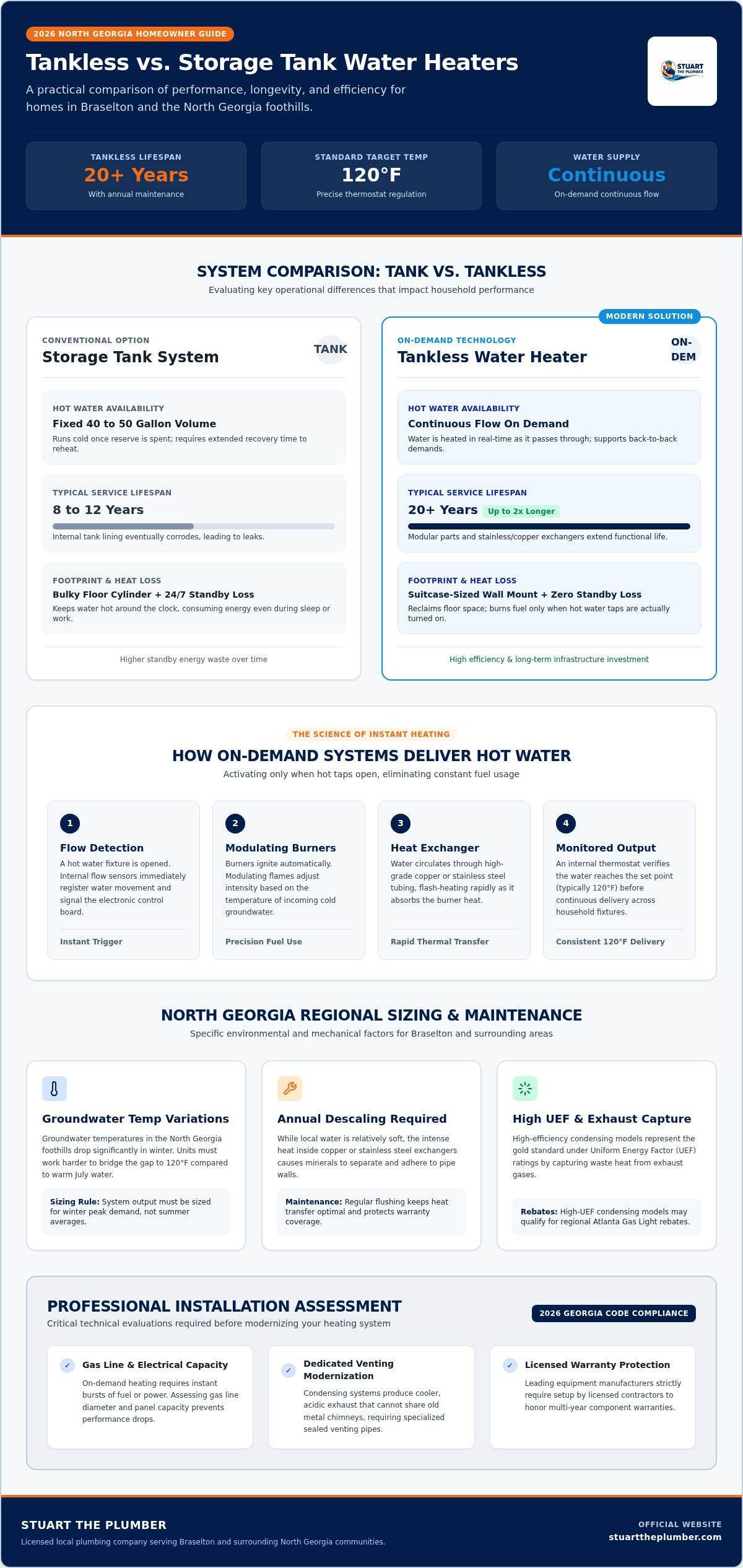
  • Braselton Water Heater Installation: 2026 Buying Guide

    Braselton Water Heater Installation: 2026 Buying Guide

    Imagine stepping into the shower on a chilly North Georgia morning, only to be met with a sudden blast of ice-cold water. It’s a frustrating way to start your day, and it’s often the first sign that you need to consider a professional water heater installation Braselton residents can rely on. Whether you’re dealing with a unit that’s over a decade old or you’re terrified of a catastrophic tank leak damaging your home, the pressure to make the right choice is real.

    We understand that you want a reliable system that keeps the hot water flowing without sending your utility bills through the roof. At Stuart the Plumber, LLC, we believe in straightforward, honest advice that helps you protect your property and your comfort. This 2026 guide provides the expert local guidance you need to simplify the selection and installation process for your next unit with total confidence.

    We’ll explore the differences between traditional and tankless models, explain how the latest Georgia plumbing codes impact your home, and show you how to maximize energy efficiency. You’ll learn exactly what to look for in a new system so you can enjoy peace of mind and consistent hot water for years to come.

    Key Takeaways

    • Learn why the 10 to 15 year rule is the most reliable predictor of unit failure and how to spot visual red flags like rust or moisture.
    • Compare the lower upfront costs of traditional tank heaters against the endless hot water and space-saving benefits of modern tankless systems.
    • Discover how to correctly size your new unit by understanding First Hour Rating and Gallons Per Minute to ensure your household never runs out of hot water.
    • Understand why professional water heater installation Braselton homeowners trust involves a thorough assessment of your home’s gas and electric lines for a seamless transition.
    • Gain clarity on 2026 energy efficiency standards and learn how to identify potential tax credits or utility rebates available for high-efficiency upgrades in North Georgia.

    Signs You Need Water Heater Installation in Braselton

    Identifying the right time for a water heater installation Braselton homeowners can trust often starts with a simple look at the manufacturer’s sticker. Most tank systems are designed to last between 10 and 15 years. At Stuart the Plumber, LLC, we’ve seen how North Georgia’s specific water conditions can affect these units over time. If your unit has passed the decade mark, it’s likely losing efficiency and nearing the end of its reliable service life.

    • Rust-colored water: This indicates internal corrosion that can’t be reversed and will eventually lead to a leak.
    • Moisture or puddles: Standing water around the base usually points to a structural failure in the tank shell.
    • Banging and popping: These audible warnings occur when sediment at the bottom of the tank hardens and traps air bubbles.
    • Inconsistent heat: When your showers stay lukewarm no matter how high you turn the dial, the heating elements or burner are failing.

    Age and Efficiency Decay

    Internal corrosion is a silent process that happens over many years. Inside the tank, a sacrificial anode rod protects the steel from rusting, but once that rod is spent, the tank itself begins to deteriorate. At this stage, repairs are often a temporary fix for a permanent problem. Sediment buildup acts as a thick layer of insulation between the burner and the water, forcing the unit to work much harder to reach the desired temperature. Understanding various Water heating methods can help you decide if a high-efficiency upgrade is a better long-term investment than keeping an aging tank.

    The Risk of Catastrophic Failure

    A small drip today might seem minor, but it’s often the precursor to a major flood. If the outer shell of the tank has been compromised by rust, the pressure of the water can cause it to burst without warning. The temperature and pressure relief valve is another critical component. If it’s leaking or stuck, the tank is no longer operating safely. Knowing who to call for a leaking water heater before an emergency strikes can save you thousands in property damage. A sudden tank burst can quickly escalate into a full household crisis, which is why having access to emergency plumbing North Georgia homeowners can count on is essential for protecting your home from serious structural damage. If you suspect a problem, our team at Stuart the Plumber, LLC can provide professional leak detection services to identify the source of moisture. Catching these issues early prevents property damage and allows for a planned water heater installation Braselton rather than a middle-of-the-night emergency.

    Comparing Tank vs. Tankless: Which Is Right for Your Home?

    Choosing the right technology for your next water heater installation Braselton depends on your household’s peak water usage and long-term budget. Traditional tanks remain a staple in North Georgia because they offer a reliable hot water supply with a lower initial investment. However, tankless units are gaining popularity for their longevity and efficiency. While a standard tank typically lasts 10 to 12 years, a well-maintained tankless system can serve your home for 20 years or more.

    Energy consumption is another major factor. Traditional units keep 40 to 50 gallons of water hot at all times, which leads to standby energy loss. Recent new efficiency standards highlight the shift toward more sustainable heating methods to help families reduce their monthly utility costs. By choosing a system that matches your consumption habits, you can lower your footprint without sacrificing comfort.

    Traditional Tank Water Heaters

    These units are ideal for households with consistent, standard hot water demands. They occupy more floor space, usually requiring a dedicated closet or area in the garage. Because they store water, they’re susceptible to sediment buildup, especially with the mineral content found in some local water supplies. To keep these systems running efficiently, you’ll need to perform an annual tank flush. This simple maintenance step prevents the sediment from hardening and damaging the tank’s interior lining.

    Tankless Water Heater Advantages

    Tankless systems provide hot water on demand, meaning they only heat water when a faucet is turned on. This eliminates standby loss and ensures you never run out of hot water, even during back-to-back morning showers. Their compact, wall-mounted design frees up valuable storage space in your home. Many larger families in our community are making the switch to these systems to handle high-volume needs. You can explore more about these high-efficiency options on our tankless water heater services page. If you’re still undecided on which technology fits your lifestyle, feel free to reach out to our team at Stuart the Plumber, LLC for a practical assessment before scheduling your water heater installation Braselton.

    Sizing and Efficiency: Getting the Most from Your Investment

    Sizing a water heater is a delicate balance. If the unit is too small, you’ll end up with cold showers during the morning rush. If it’s too large, you’re wasting money heating water that your family will never use. For a successful water heater installation Braselton residents must look beyond the physical size of the tank and focus on performance metrics like First Hour Rating (FHR) and Gallons Per Minute (GPM).

    Traditional tanks are measured by their FHR, which identifies how much hot water the unit can deliver during a single hour of peak demand. Tankless systems are different; they’re rated by GPM. This flow rate determines how many fixtures can run simultaneously without a drop in temperature. Choosing an Energy Star certified unit can provide a high return on investment by qualifying for 2026 federal tax credits and reducing monthly utility costs.

    Determining Your Household Peak Demand

    To get sizing right, you need to count your simultaneous hot water fixtures. A standard shower typically uses 2.5 GPM, while a dishwasher or washing machine uses about 1.5 to 2.0 GPM. If you plan to run the laundry and the shower at the same time, your system needs to handle at least 4.5 GPM. Sizing up isn’t always the best move for efficiency, as an oversized tank leads to higher standby energy loss. Here’s a quick reference for standard tank capacities:

    • 1-2 People: 30 to 40 gallon tank
    • 3-4 People: 50 to 60 gallon tank
    • 5+ People: 80 gallon tank or a high-capacity tankless system

    Local Considerations for North Georgia

    Our regional climate in North Georgia significantly impacts heater performance. During the winter, inlet water temperatures drop. This means your heater has to work much harder to raise the water temperature to a comfortable 120 degrees than it would in a warmer climate. Additionally, local plumbing codes often require the installation of thermal expansion tanks. These small tanks act as a safety buffer, absorbing the extra pressure created as water expands during the heating process. Professional sizing prevents your system from overworking, which stops premature unit burnout before it starts. If your home was built between 1978 and 1995, it’s also worth confirming your supply lines are up to current standards, as polybutylene pipe replacement Georgia homeowners have needed can directly affect water pressure and heater performance.

    Braselton Water Heater Installation: 2026 Buying Guide

    The Stuart The Plumber Process: Reliable Local Installation

    Once you’ve selected the right unit, the physical water heater installation Braselton homeowners expect begins with a detailed assessment. We check your existing gas or electric lines to ensure they’re ready for the new technology. We handle the heavy lifting, from draining the old tank to safely removing it from your property. Our team focuses on a precision setup where every connection meets the latest safety standards, including the 2024 International Plumbing Code with Georgia amendments. We don’t just leave once the water is hot; we provide a full walkthrough to show you how to operate your new system and maintain it for the long haul.

    What to Expect on Installation Day

    A standard water heater swap typically takes a few hours to complete. We know your home is your sanctuary, so we take extra steps to protect your property. We use floor runners and careful handling techniques to ensure your floors and walls remain untouched during the removal of the old unit. At Stuart The Plumber, we treat your house with the same respect we’d show our own. You can learn more about Stuart The Plumber and our deep roots in the North Georgia community.

    Why Choose a Licensed Local Plumber?

    It’s tempting to hire a general handyman for a quick fix, but a licensed professional brings a different level of security. We understand the specific plumbing codes and permit requirements for water heater installation Braselton and surrounding areas. Our commitment is to honesty and straightforward communication. We’ll tell you exactly what’s needed without any high-pressure sales tactics. This reliable, neighborly approach is how we’ve built a reputation serving residents in Hoschton, Buford, and across the region. We focus on getting the job done right the first time so you can get back to your routine with total peace of mind.

    Secure Your Home’s Hot Water Supply

    Choosing a new water heater doesn’t have to be a stressful experience. By recognizing the early warning signs of tank failure and understanding the long-term benefits of modern efficiency standards, you can make a choice that protects your property and your wallet. Whether you decide on a traditional tank or a high-efficiency tankless system, getting the sizing right for our specific North Georgia climate is the key to consistent comfort.

    As licensed and insured North Georgia experts, Stuart The Plumber is here to provide the honest, local guidance you deserve. We’re a locally owned and operated company specializing in both tank and tankless systems. Our team is ready to handle every detail of your water heater installation Braselton project with precision and care, ensuring your home meets all current safety standards.

    Don’t wait for a cold shower or a flooded basement to take action. Upgrading your system today means lower utility bills and more reliable performance. Invest in your peace of mind and enjoy reliable hot water for years to come.

    Common Questions About Water Heater Installation

    How long does it take to replace a water heater?

    A standard replacement typically takes between two and four hours to complete. This timeframe includes draining the old tank, disconnecting the supply lines, and positioning the new unit. If you’re switching from a traditional tank to a tankless system, the process takes longer because we need to modify gas lines or venting. For a detailed breakdown of every step in the process, see our complete guide on how long does it take to replace a water heater. Stuart The Plumber prioritizes a methodical approach to ensure every connection is secure before we leave your home.

    Is it better to repair or replace my water heater?

    Use the age and cost rule to decide. If your unit is over 10 years old or the repair cost is more than half the price of a new unit, replacement is usually the smarter investment. A leaking tank cannot be repaired and requires immediate water heater installation Braselton homeowners can rely on. We recommend repairs for minor issues like a failed heating element or a faulty thermostat on newer units.

    Do I need a permit for water heater installation in Braselton?

    Yes, a plumbing permit is required for almost all water heater installations in Georgia, including like-for-like replacements. If you’re installing a gas-fired unit, you will also need a gas permit. These regulations ensure the installation meets the 2024 International Plumbing Code with Georgia amendments. As a licensed local company, Stuart The Plumber follows these rules to ensure your home remains compliant with local safety standards and building codes.

    What is the difference between a power vent and a standard vent heater?

    The primary difference is how the unit exhausts combustion gases from your home. Standard vent heaters use a vertical chimney to let hot air rise naturally. Power vent models use a blower fan to push gases through a horizontal pipe, usually made of PVC. This allows for more flexible placement. While power vent units are more energy-efficient, they require an electrical outlet nearby and are slightly louder than standard atmospheric models.

    Can I switch from an electric water heater to a gas model?

    You can switch, but it requires significant modifications to your home’s infrastructure. We must install a dedicated gas line and a proper venting system to exhaust combustion gases safely. This often involves cutting through walls or the roof. While the initial setup for a gas water heater installation Braselton project is more complex, many residents prefer it because gas units have faster recovery rates and often lower monthly operating costs.

    How often should I have my new water heater serviced?

    You should schedule a professional maintenance visit at least once a year. For traditional tanks, this service includes flushing the unit to remove sediment buildup and checking the sacrificial anode rod. Tankless systems require annual descaling to prevent mineral deposits from clogging the heat exchanger. Regular service from Stuart The Plumber extends the life of your equipment, maintains energy efficiency, and helps prevent unexpected leaks that could damage your property. If your home has older plumbing infrastructure, you may also want to review our guide on polybutylene pipe replacement in Georgia to ensure your entire system is safe and up to current standards.

    Stuart Balestracci

    Article by

    Stuart Balestracci

    Stuart is a third-generation master plumber dedicated to providing dependable, honest plumbing service throughout Braselton and North Georgia. Building on a family tradition of hands-on trade expertise, he brings practical problem-solving and high standards to every job—from urgent leaks and clogged drains to water heaters, sewer lines, and whole-home repiping.

    Stuart believes customers deserve clear answers, quality workmanship, and repairs that address the real issue—not a quick fix that creates another problem later. Through Stuart the Plumber, LLC, he serves homeowners, property managers, and businesses with professional service, straightforward communication, and respect for their property. The company operates as a licensed Georgia plumbing business, license MP208668.

    Disclaimer

    The information in this article is provided for general educational and informational purposes only. While Sturat the Plumber, LLC makes reasonable efforts to keep information accurate and current, plumbing conditions, building systems, local codes, manufacturer instructions, and repair requirements vary by property and may change over time.

    This content is not a substitute for an on-site inspection, diagnosis, estimate, professional plumbing service, or advice from a properly licensed professional. Do not rely on this article to diagnose gas leaks, sewer backups, hidden water leaks, water-heater failures, burst pipes, or other potentially hazardous conditions.

    Plumbing work can involve risks including water damage, electrical hazards, gas hazards, sewage exposure, structural damage, and personal injury. Always follow applicable local codes, product instructions, and safety requirements. For active leaks, suspected gas leaks, sewage backups, flooding, loss of water service, or any situation that may create an immediate safety risk, contact a qualified professional or emergency services as appropriate.

    Sturat the Plumber, LLC does not guarantee that the information in this article is complete, suitable for every property, or applicable to your specific circumstances. Any decisions or actions taken based on this content are at your own risk. Sturat the Plumber, LLC disclaims liability for loss, damage, injury, expense, or other consequences arising from the use of or reliance on this information.

    For an evaluation of your specific plumbing concern, contact Sturat the Plumber, LLC for professional service. Sturat the Plumber, LLC is a licensed Georgia plumbing business, license MP208668.
  • Commercial Plumber in Braselton, GA: Licensed Expert Services for 2026

    Commercial Plumber in Braselton, GA: Licensed Expert Services for 2026

    What if a hidden leak beneath your shop’s floor is quietly eroding your foundation while you focus on daily sales? In North Georgia, plumbing failures aren’t just inconveniences; they’re significant liabilities that can lead to insurance denials and expensive code violations. Finding a reliable commercial plumber Braselton GA is the first step in safeguarding your property value and ensuring long-term system reliability. You need a partner who understands the local soil conditions and municipal requirements without the need for high-pressure sales tactics or confusing industry jargon.

    Stuart the Plumber, LLC provides the licensed expertise needed to navigate the 2026 Georgia State Plumbing Code and handle heavy underground utilities. Whether you’re dealing with complex grease traps or require a full facility repipe, we offer the straightforward, professional resolution your business deserves. This guide explores why choosing a credentialed local expert is critical for your property’s health and how we manage the “heavy lifting” of commercial plumbing with neighborly integrity and technical precision.

    Key Takeaways

    • Understand why a Georgia state license is the only way to protect your commercial property from insurance claim denials and code violations.
    • Learn how a specialized commercial plumber Braselton GA handles complex underground utilities, including grease trap installation for restaurant compliance.
    • Discover how professional leak detection technology can identify hidden issues before they cause expensive damage to your building’s foundation.
    • Find out how modernizing older North Georgia structures with polybutylene pipe replacement can prevent catastrophic system failures.
    • Get a clear look at the Stuart the Plumber, LLC service process, emphasizing direct communication and thorough site cleanup.

    Why a Licensed Commercial Plumber in Braselton, GA is Critical

    A licensed professional is more than just a technician; they are a state-certified expert vetted by the Georgia State Board of Construction Industry. Choosing a commercial plumber Braselton GA ensures your property remains compliant with the latest mandatory statewide codes, including the 2024 International Plumbing Code and its specific Georgia amendments. Working with uncredentialed contractors creates a significant legal risk, as many insurance providers will deny water damage claims if the work wasn’t performed by a licensed master plumber. This technical safeguard is the only way to verify that your facility’s Plumbing systems meet the rigorous safety standards required by both Jackson and Gwinnett County authorities.

    Georgia Licensing vs. Handyman Services

    While a handyman might handle minor cosmetic repairs, complex commercial tasks like grease trap replacement or service line installation require the rigorous training associated with a Georgia Master Plumber license. This credential requires thousands of hours of documented field experience and passing comprehensive state exams that test knowledge of safety and sanitation. Stuart the Plumber, LLC maintains this high level of certification to provide Braselton business owners with essential liability protection. If a system failure occurs, having a licensed professional on record ensures that your maintenance history adheres to industry best practices and local legal requirements.

    Local Infrastructure and Building Codes

    Braselton sits in a region with specific soil conditions and water table levels that directly impact underground utility work. A local commercial plumber Braselton GA understands these North Georgia variables and how they affect the durability of your pipes. This expertise is particularly valuable for navigating the municipal permitting process for new commercial construction or major renovations. Our team focuses on clearing these regulatory hurdles efficiently, ensuring your water service line installation meets local depth and material standards without the delays that often plague projects handled by out-of-town contractors.

    • Verification of compliance with EPA WaterSense-certified high-efficiency fixture mandates.
    • Ensuring all underground work accounts for North Georgia’s specific clay soil density.
    • Coordination with city inspectors to verify that all utility connections meet current safety marks.

    Comprehensive Solutions for Braselton Commercial Properties

    High-traffic commercial facilities in North Georgia require more than standard residential fixes. They need plumbing systems that can withstand constant use and high pressure without failing under the strain. Stuart the Plumber, LLC offers a full suite of services designed specifically for the rigors of commercial operations. As a seasoned commercial plumber Braselton GA, we prioritize efficiency to keep your business running without interruption. Our approach combines technical expertise with the right tools for heavy-duty environments.

    Commercial Leak Detection and Foundation Protection

    Foundation leaks are a quiet threat to commercial structures in our area. You might notice damp spots on carpets or a sudden, unexplained spike in your monthly utility bill. These are common warning signs of a slab leak that could eventually compromise your building’s structural integrity. We use advanced technology for professional leak detection in Braselton, GA to locate the source without digging up your entire floor. Finding these issues early prevents foundation erosion and mold growth while minimizing business disruption.

    High-Performance Drain and Sewer Cleaning

    Retail centers and local restaurants deal with heavy grease and debris that standard snakes simply can’t clear. We utilize high-pressure sewer jetting to scour the inside of your pipes and restore full flow. This sewer jetting service in Georgia is the most effective way to clear stubborn blockages and prevent future backups. Safety is always our first priority during these heavy-duty operations. We strictly follow OSHA safety standards to ensure a secure work environment for our team and your staff.

    Commercial Water Heater Solutions

    A lack of hot water can halt production in a commercial kitchen or medical office instantly. We specialize in high-capacity water heater repair and replacement for both traditional and tankless systems. Tankless units are often preferred in Braselton for their ability to provide continuous hot water on demand while taking up less space. To keep these systems running at peak performance, we recommend annual flushing to remove mineral buildup. If you’re experiencing fluctuating temperatures, it’s a good idea to talk with our team about a professional assessment before a total failure occurs.

    When a pipe bursts or a main line backs up, you need a quick, professional response from someone who knows the area. Stuart the Plumber, LLC handles emergency situations across North Georgia with a focus on immediate stabilization. We understand that every hour of downtime is lost revenue, so we work to provide a professional resolution as efficiently as possible.

    Specialized Commercial Pipe and Utility Services

    Specialized utility work requires a level of expertise that goes beyond basic indoor repairs. For many businesses, the most critical components of their plumbing system are buried deep underground or hidden behind walls. Finding a qualified commercial plumber Braselton GA is essential when your facility needs heavy-duty pipe replacement or municipal compliance upgrades. Stuart The Plumber specializes in these high-stakes projects, ensuring your infrastructure is built to last. We focus on durable results that protect your property and your bottom line.

    Grease Trap Installation and Replacement

    Braselton restaurants must adhere to strict environmental standards to prevent fats, oils, and grease from entering the municipal sewer system. Proper grease trap installation involves precise sizing based on your kitchen’s peak output. If you notice persistent foul odors or slow-moving floor drains, your current unit may be failing. We replace outdated or undersized traps with modern systems that meet all Georgia environmental regulations. This helps you avoid heavy municipal fines and prevents the kind of backups that can force an emergency shutdown.

    The Polybutylene Pipe “Ticking Time Bomb”

    Many commercial units and older properties in North Georgia still contain polybutylene piping. This material is often called a ticking time bomb because it can become brittle and burst without any external warning signs. Over time, the chemicals used to treat local water supplies cause the plastic to flake and crack from the inside out. We help property owners mitigate this risk through professional repiping. Replacing these old lines with durable PEX or copper modernizes your structure. This proactive step often leads to lower insurance premiums and a measurable increase in property value.

    Heavy Underground Waterline Installation

    Managing a main service line break requires specialized equipment and a deep understanding of Georgia plumber licensing requirements. Our team handles the heavy lifting involved in heavy commercial waterline installation and repair. We prioritize trenchless options whenever possible. This technology allows us to replace or repair deep underground pipes without destroying your parking lot or landscaping. Stuart The Plumber is the commercial plumber Braselton GA trusts to resolve sewer line breaks and service line failures with minimal surface disruption.

    Commercial Plumber in Braselton, GA: Licensed Expert Services for 2026

    Your Trusted Neighborly Plumber in North Georgia

    Choosing a commercial plumber Braselton GA means finding a partner who values your business’s uptime as much as you do. At Stuart The Plumber, our process is designed to be as efficient and transparent as possible. We begin every project with a thorough diagnosis to identify the root cause of the issue. Once we have a clear plan, we perform the necessary repairs or installations using professional-grade materials. Our work isn’t finished until we conduct a final inspection and a complete site cleanup. We believe that a job well done includes leaving your property in better shape than we found it.

    Direct communication is the foundation of our service. We don’t use confusing jargon or high-pressure sales tactics to create a sense of urgency. Instead, we provide practical solutions and clear explanations so you can make informed decisions about your property. This no-nonsense attitude has made us a dependable resource for property managers who need honest assessments and reliable results. We treat every commercial facility with the same respect we would show a neighbor’s home.

    Our service area extends well beyond the Braselton city limits. We are proud to serve the wider North Georgia region, providing expert plumbing support in Hoschton, Winder, and Gainesville. Being locally owned and operated gives us a unique perspective on the challenges facing businesses in our community. We know the local codes, the regional infrastructure, and the specific needs of North Georgia property owners.

    Our Commitment to the Braselton Community

    Local accountability is vital when managing a commercial property. If a problem arises, you need to know that your contractor is just a phone call away and deeply invested in the community’s success. We combine the technical precision of a state-licensed contractor with the approachable, neighborly service that defines our brand. You can learn more about our history and our dedication to quality by visiting our About Stuart The Plumber page.

    Scheduling Your Commercial Service

    Whether you are dealing with a plumbing emergency or planning a system upgrade, we are ready to help. We maintain a consistent presence in Braselton and the surrounding towns, ensuring we can reach your facility when you need us most. Protecting your commercial investment starts with a reliable plumbing system. Contact Stuart The Plumber today to schedule a professional consultation and keep your business running smoothly.

    Secure Your Facility with Expert Plumbing Solutions

    Maintaining a commercial property in North Georgia requires a proactive approach to plumbing infrastructure. From ensuring grease traps meet current environmental codes to modernizing older buildings through polybutylene replacement, the technical details matter. Stuart The Plumber is a licensed Georgia Plumbing Contractor committed to providing the community with reliable, neighborly service. We specialize in the heavy underground utility work and grease trap services that many general contractors avoid; this gives you a single point of contact for complex facility needs.

    Choosing an expert commercial plumber Braselton GA ensures that your repairs are handled with the precision required by state board standards. Being locally owned and operated means we understand the specific challenges of our region’s soil and water systems. We focus on long-term reliability so you can stay focused on your daily business operations. Our team is ready to help you safeguard your property and maintain compliance with straightforward, honest service.

    We look forward to helping your business thrive with a dependable plumbing system you can trust.

    Frequently Asked Questions

    How do I verify a Georgia commercial plumbing license?

    You can verify a license through the Georgia Secretary of State’s online portal. Search the Professional Licensing Boards database by the individual’s name or business license number. A commercial project requires a Master Plumber license to ensure the work meets state safety codes. As a licensed commercial plumber Braselton GA, Stuart The Plumber encourages all property managers to verify credentials before any major utility work begins on their site.

    What are the signs that my business needs grease trap replacement?

    Signs of a failing grease trap include persistent foul odors in the kitchen, slow-moving floor drains, or frequent sewage backups. If your unit is physically corroded or requires cleaning much more often than usual, it may be time for a grease trap replacement. Stuart The Plumber provides expert installation for Braselton businesses to ensure your facility remains compliant with local environmental regulations and avoids heavy municipal fines.

    Does Stuart The Plumber handle trenchless sewer repair in Braselton?

    Yes, we specialize in trenchless pipe replacement for businesses throughout the Braselton area. This technology allows us to repair or replace damaged sewer lines without the need for massive trenches that disrupt your parking lot or landscaping. It’s a faster, cleaner alternative to traditional excavation. Stuart The Plumber utilizes this method to maintain your facility’s integrity while minimizing the impact on your daily commercial operations and customer access.

    Why is my commercial water pressure low?

    Low water pressure in a commercial setting often stems from a malfunctioning pressure-reducing valve or mineral buildup in high-traffic fixtures. However, it can also indicate a more serious issue like a hidden slab leak. Hiring a commercial plumber Braselton GA for professional leak detection is the best way to identify the cause. We use advanced diagnostic tools to find underground breaks that might be starving your building of necessary water flow.

    How long does a commercial water heater installation take?

    Installation time varies based on whether you are installing a traditional high-capacity tank or a modern tankless system. Factors like existing gas line capacity, venting requirements, and the complexity of the plumbing manifold all influence the project’s length. Stuart The Plumber prioritizes a methodical approach to ensure every connection is secure and code-compliant. We work to complete the process as efficiently as possible to restore hot water to your facility.

    Are polybutylene pipes common in Braselton commercial properties?

    Polybutylene pipes are quite common in Braselton properties constructed between 1978 and 1995. These pipes are often described as a ticking time bomb because they fail from the inside out due to chemical reactions with treated water. Stuart The Plumber specializes in polybutylene replacement for commercial units across North Georgia. Modernizing your system with durable materials like PEX or copper prevents sudden, catastrophic leaks and helps protect your overall property value.

    Stuart Balestracci

    Article by

    Stuart Balestracci

    Stuart is a third-generation master plumber dedicated to providing dependable, honest plumbing service throughout Braselton and North Georgia. Building on a family tradition of hands-on trade expertise, he brings practical problem-solving and high standards to every job—from urgent leaks and clogged drains to water heaters, sewer lines, and whole-home repiping.

    Stuart believes customers deserve clear answers, quality workmanship, and repairs that address the real issue—not a quick fix that creates another problem later. Through Stuart the Plumber, LLC, he serves homeowners, property managers, and businesses with professional service, straightforward communication, and respect for their property. The company operates as a licensed Georgia plumbing business, license MP208668.

    Disclaimer

    The information in this article is provided for general educational and informational purposes only. While Sturat the Plumber, LLC makes reasonable efforts to keep information accurate and current, plumbing conditions, building systems, local codes, manufacturer instructions, and repair requirements vary by property and may change over time.

    This content is not a substitute for an on-site inspection, diagnosis, estimate, professional plumbing service, or advice from a properly licensed professional. Do not rely on this article to diagnose gas leaks, sewer backups, hidden water leaks, water-heater failures, burst pipes, or other potentially hazardous conditions.

    Plumbing work can involve risks including water damage, electrical hazards, gas hazards, sewage exposure, structural damage, and personal injury. Always follow applicable local codes, product instructions, and safety requirements. For active leaks, suspected gas leaks, sewage backups, flooding, loss of water service, or any situation that may create an immediate safety risk, contact a qualified professional or emergency services as appropriate.

    Sturat the Plumber, LLC does not guarantee that the information in this article is complete, suitable for every property, or applicable to your specific circumstances. Any decisions or actions taken based on this content are at your own risk. Sturat the Plumber, LLC disclaims liability for loss, damage, injury, expense, or other consequences arising from the use of or reliance on this information.

    For an evaluation of your specific plumbing concern, contact Sturat the Plumber, LLC for professional service. Sturat the Plumber, LLC is a licensed Georgia plumbing business, license MP208668.

  • Sewer Jetting Service in Georgia: Deep Cleaning Solutions for Your Main Lines

    Sewer Jetting Service in Georgia: Deep Cleaning Solutions for Your Main Lines

    That stubborn drain clog you keep snaking isn’t just a nuisance. It’s a warning sign that your main line is losing the battle against Georgia’s aggressive tree roots and heavy clay soil. Most homeowners in Braselton and North Georgia feel the frustration of recurring backups. You pay for a quick fix, only for the water to pool around your ankles again a few weeks later. It’s stressful to wonder if the next flush will be the one that causes a messy, expensive backup into your home.

    We understand that you want a permanent solution rather than a temporary patch. Investing in a professional sewer jetting service Georgia property owners trust does more than just poke a hole in the debris. It provides a structural reset that scours your pipes clean to a like-new condition. Stuart the Plumber, LLC is here to help you regain peace of mind. In this guide, we’ll explain how high-pressure water technology removes years of sludge, why it’s the best defense against invasive roots, and exactly what happens during the jetting process to ensure your plumbing stays clear for the long haul.

    Key Takeaways

    • Learn why high-pressure hydro-jetting provides a long-term structural reset for your pipes rather than just a temporary patch.
    • Identify the specific red flags that signal a main line blockage before it leads to an expensive emergency backup in your home.
    • Understand the professional diagnostic process that ensures a safe and effective sewer jetting service Georgia property owners can rely on for tough clogs.
    • See how specialized equipment and nozzles handle the unique challenges of North Georgia soil and invasive tree root growth.
    • Gain clarity on why hiring a licensed local expert like Stuart The Plumber is the best way to protect your property’s long-term pipe health.

    Understanding Sewer Jetting: Why Georgia Sewer Lines Need Deep Cleaning

    Sewer jetting, also known as hydro-jetting, is a specialized cleaning method that uses high-pressure water to blast through the toughest obstructions in your main line. It isn’t just a way to poke a hole through a clog. It’s a comprehensive cleaning process that acts as a structural reset for the interior of your pipes. Over years of use, sewer lines collect layers of debris that narrow the passage, making backups more likely. A professional sewer jetting service Georgia residents trust can restore your pipes to their original flow capacity and health.

    The Difference Between Snaking and High-Pressure Jetting

    Many homeowners are familiar with traditional drain snaking. A mechanical auger uses a metal cable to break apart a solid blockage. While this works for immediate relief, it often leaves a significant amount of residue behind. Snaking is a temporary fix for recurring North Georgia drain issues because the remaining grease and sludge quickly catch new debris, leading to another backup in a matter of weeks.

    Jetting is different. It uses a 360-degree water scouring action to remove grease, scale, and even fine roots from the pipe walls. While a snake clears a path, jetting cleans the entire surface. This thorough approach is why Stuart The Plumber often recommends jetting for lines that suffer from chronic slow drains or frequent clogs. It’s the difference between clearing a path and cleaning the house.

    Common Sewer Blockages in North Georgia Properties

    Our local environment plays a huge role in plumbing health. Georgia’s dense red clay and native trees create a perfect storm for sewer problems. Understanding what is hiding inside your pipes helps you choose the right solution. Common issues we see include:

    • Tree root intrusion: Georgia oaks and pines are notorious for seeking moisture. They can find tiny gaps in pipe joints and grow into massive root balls inside your line.
    • Grease and scale: In older homes in Braselton and Jefferson, cooking fats and minerals build up into a concrete-like substance.
    • Construction debris: In rapidly developing areas like Hoschton, silt and gravel often find their way into main lines during new builds.

    Stuart The Plumber provides the expert equipment needed to flush these materials away, ensuring your home’s plumbing remains reliable. By removing the root cause of the blockage, we help you avoid the high costs of emergency repairs and property damage.

    The Sewer Jetting Process: What to Expect During Your Service

    Our approach to a sewer jetting service Georgia homeowners trust is methodical and transparent. We don’t believe in guesswork. High-pressure water is a powerful tool, so we treat your property with the respect it deserves. By following a strict professional protocol, Stuart The Plumber ensures the job is done right the first time without risking the integrity of your plumbing system. It’s a clean, efficient way to restore your main line to its best possible condition.

    Step 1: Video Camera Sewer Line Inspection

    We always start with a visual. A high-definition camera is fed into the line to pinpoint the exact location and nature of the blockage. This diagnostic step is vital for finding hidden water leaks and assessing the physical condition of your pipes. We check for cracks, shifts, or collapses that might make high-pressure cleaning unsafe for older systems. We want to be certain your pipes are strong enough for the process before the water starts flowing.

    Step 2: Scouring the Pipes with High-Pressure Water

    Once we confirm the pipe is sound, we insert a specialized hose through a cleanout or access point. This hose features interchangeable nozzles designed to tackle specific problems, from soft grease sludge to woody tree roots. Backward-firing jets propel the hose deep into the line while a forward-facing jet cuts through the obstruction. This process flushes all debris out toward the municipal line, leaving the interior walls of your pipe scoured clean.

    Maintaining your main line prevents hazardous overflows that can damage your yard and home. Recognizing the signs your property needs professional sewer jetting helps prevent these costly situations. Our process uses only clean water. There are no harsh chemicals that could corrode your pipes or leak into the North Georgia soil. It’s an effective, eco-friendly solution that provides long-term results for your plumbing system. If you’re tired of dealing with slow drains, you can reach out to our team for a professional assessment.

    Signs Your Property Needs Professional Sewer Jetting

    Recognizing the difference between a simple sink clog and a main line disaster is essential for every Georgia property owner. A single backed-up drain is usually a local issue you can handle with a plunger. However, when the problem affects your entire system, it’s time for professional intervention. Ignoring these warning signs can lead to structural damage and significant health risks. A professional sewer jetting service Georgia residents trust is often the only way to clear deep-seated obstructions safely.

    Red Flags for Residential Homeowners

    If you notice multiple slow drains throughout your house occurring simultaneously, your main line is likely restricted. This isn’t a job for DIY chemical cleaners. These products contain harsh acids that can eat through older cast iron or warp PVC pipes without ever reaching the actual blockage. Instead, look for these specific indicators:

    • Gurgling noises coming from toilets or floor drains when water is running elsewhere.
    • Water backing up into the shower or tub when you flush the toilet.
    • Sewage odors or unusual wet spots in the yard near the sewer line path.

    Understanding the causes of sewer overflows is the first step toward protecting your family from the bacteria and property damage associated with main line failures. If you want to learn more about why these problems develop, our detailed guide on clogged drain North Georgia causes and professional solutions explains how local red clay and shifting soil contribute to these issues. Stuart The Plumber uses advanced diagnostics to ensure we address the root cause of the problem rather than just the symptoms.

    Commercial Needs: Keeping Main Lines and Grease Traps Clear

    Restaurants and commercial kitchens in Braselton face unique challenges. Grease, fats, and oils quickly solidify inside plumbing, leading to narrowed pipes and sudden backups. Scheduling a regular sewer jetting service Georgia business owners rely on prevents these issues before they cause a health code violation or forced downtime.

    Sewer jetting plays a vital role in keeping your Grease Trap installation functioning correctly. While the trap catches most solids, fine particles and liquid fats still make it into the main line. High-pressure water scouring is the only way to remove this sticky residue completely. We help local businesses maintain their utility lines so they can focus on serving customers instead of managing plumbing emergencies.

    Sewer Jetting Service in Georgia: Deep Cleaning Solutions for Your Main Lines

    Professional Sewer Jetting in Braselton and North Georgia

    Stuart The Plumber serves as your local alternative to the large, impersonal franchises based in Atlanta. We live and work in the same communities we serve, from Braselton to Hoschton and Jefferson. Choosing a sewer jetting service Georgia experts provide ensures your technician understands the specific plumbing challenges of our region. We don’t just treat you like a service ticket; we treat you like a neighbor. Our goal is to provide a permanent resolution that keeps your home running smoothly.

    Why Choose a Licensed Local Plumber for Your Main Lines

    High-pressure water jetting is a powerful process that requires precision. In the hands of an unlicensed contractor, the equipment can easily damage older pipes or cause structural failure. Stuart The Plumber brings specialized expertise and the right equipment to every job in Winder and Buford. Our team stays current on Georgia plumbing codes to ensure every service is performed safely and correctly. You gain peace of mind knowing your property is managed by a licensed professional who values honesty and transparency.

    Scheduling Your Preventive Maintenance

    Don’t wait for a heavy North Georgia rainstorm to discover a blockage. Excessive stormwater can quickly overwhelm a restricted line, leading to a catastrophic backup into your home. We recommend jetting your lines periodically, especially if you live on a lot with mature trees or have an older plumbing system. This proactive approach prevents the high costs and stress of emergency burst pipe repairs. It’s an investment in your property’s long-term health. Taking the next step is simple: Contact Stuart The Plumber for a line inspection to see if your system is a candidate for a deep clean.

    Restore Your Peace of Mind with a Clear Main Line

    Recurring clogs don’t have to be a way of life for your North Georgia property. Choosing a professional sewer jetting service Georgia residents can rely on means moving past temporary snaking and actually cleaning your pipes to their core. Stuart The Plumber uses advanced video camera inspection technology to ensure every job starts with a clear diagnosis and ends with a fully restored system. As a licensed and insured local plumber, we prioritize the long-term health of your home’s infrastructure over quick, surface-level fixes.

    You deserve a plumbing system that works without the constant fear of a backup. We’re proud to serve our neighbors in Braselton and the surrounding communities with honest, expert care. By addressing the root causes of blockages now, you protect your property from future emergencies. Take the first step toward a worry-free home today.

    Frequently Asked Questions

    Is sewer jetting safe for older pipes in Georgia homes?

    Yes, sewer jetting is safe for older pipes when a professional camera inspection is performed first. Stuart The Plumber uses high-definition cameras to check for structural integrity before starting the process. If your pipes are brittle or already collapsed, we’ll recommend a different repair path. For sound pipes, we adjust the water pressure to ensure a thorough clean that’s much safer than using corrosive DIY chemical cleaners.

    How much does a sewer jetting service cost in North Georgia?

    The cost of a sewer jetting service Georgia residents receive depends on several specific factors. These include the total length of the sewer line, the severity of the blockage, and how easily we can access your cleanout. Heavy root intrusion or massive grease build-up may require more time and specialized nozzles. We recommend scheduling a professional diagnostic visit so we can provide an accurate estimate based on your property’s unique needs.

    Can sewer jetting remove tree roots from my main line?

    Sewer jetting is one of the most effective ways to clear invasive tree roots from your plumbing. We use specialized cutting nozzles that use high-pressure water to saw through root masses and flush them out of the pipe completely. While this restores your flow immediately, it doesn’t seal the cracks where roots first entered. We often suggest follow-up inspections to monitor these areas and prevent the roots from growing back over time.

    How long does a typical sewer jetting service take?

    Most residential appointments in Braselton or Hoschton take between one and three hours to complete. This window allows our team to perform a thorough video camera inspection, set up the equipment, and scour the lines until they’re clear. If we’re dealing with extreme blockages or a very long commercial line, the process might take a bit longer. We work efficiently to minimize any disruption to your home’s water usage during the service.

    Will sewer jetting fix a broken or collapsed sewer pipe?

    No, sewer jetting is a deep-cleaning solution rather than a structural repair. It’s designed to remove debris, grease, and roots from pipes that are still physically sound. If our initial camera inspection shows that a pipe has collapsed or shifted significantly, we’ll discuss repair options like service line installation or re-piping. Jetting a broken pipe can lead to further damage, which is why our diagnostic step is so important for your property.

    How often should a commercial property have its lines jetted?

    Most commercial properties in North Georgia should consider preventive jetting every six to twelve months. Restaurants and commercial kitchens usually require more frequent service because of heavy grease and food waste. Regular maintenance prevents sudden backups that could lead to health code violations or forced closures. Stuart The Plumber can help you establish a custom schedule based on your business’s specific volume and the current condition of your underground utility lines. For a broader look at keeping your entire main line system healthy, our complete guide to sewer drain cleaning Georgia homeowners rely on for main line care covers everything from identifying blockages to choosing the right cleaning method.

    Stuart Balestracci

    Article by

    Stuart Balestracci

    Stuart is a third-generation master plumber dedicated to providing dependable, honest plumbing service throughout Braselton and North Georgia. Building on a family tradition of hands-on trade expertise, he brings practical problem-solving and high standards to every job—from urgent leaks and clogged drains to water heaters, sewer lines, and whole-home repiping.

    Stuart believes customers deserve clear answers, quality workmanship, and repairs that address the real issue—not a quick fix that creates another problem later. Through Stuart the Plumber, LLC, he serves homeowners, property managers, and businesses with professional service, straightforward communication, and respect for their property. The company operates as a licensed Georgia plumbing business, license MP208668.
    Disclaimer

    The information in this article is provided for general educational and informational purposes only. While Sturat the Plumber, LLC makes reasonable efforts to keep information accurate and current, plumbing conditions, building systems, local codes, manufacturer instructions, and repair requirements vary by property and may change over time.

    This content is not a substitute for an on-site inspection, diagnosis, estimate, professional plumbing service, or advice from a properly licensed professional. Do not rely on this article to diagnose gas leaks, sewer backups, hidden water leaks, water-heater failures, burst pipes, or other potentially hazardous conditions.

    Plumbing work can involve risks including water damage, electrical hazards, gas hazards, sewage exposure, structural damage, and personal injury. Always follow applicable local codes, product instructions, and safety requirements. For active leaks, suspected gas leaks, sewage backups, flooding, loss of water service, or any situation that may create an immediate safety risk, contact a qualified professional or emergency services as appropriate.

    Sturat the Plumber, LLC does not guarantee that the information in this article is complete, suitable for every property, or applicable to your specific circumstances. Any decisions or actions taken based on this content are at your own risk. Sturat the Plumber, LLC disclaims liability for loss, damage, injury, expense, or other consequences arising from the use of or reliance on this information.

    For an evaluation of your specific plumbing concern, contact Sturat the Plumber, LLC for professional service. Sturat the Plumber, LLC is a licensed Georgia plumbing business, license MP208668.