

What if you never had to worry about the shower turning ice-cold just because someone else started the dishwasher? For many families in Braselton and the surrounding North Georgia area, the traditional water heater is a source of constant frustration. You’re likely tired of paying to heat a massive 50-gallon tank 24 hours a day, only to run out of hot water during back-to-back morning routines. If you’re also worried about a potential tank leak damaging your basement or garage, it’s time to consider a modern solution.
Choosing a tankless water heater installation Georgia homeowners can trust is about more than just convenience; it’s about efficiency and peace of mind. At Stuart the Plumber, LLC, we’ve helped countless neighbors reclaim their utility closets and lower their monthly bills. In this 2026 guide, you’ll discover if an on-demand system fits your household’s specific needs and exactly what the professional installation process involves. We’ll cover everything from the latest 2026 Georgia plumbing codes and local Atlanta Gas Light rebates to how our groundwater temperatures affect system sizing. By the end, you’ll know exactly how to achieve endless hot water for your family.
Key Takeaways
- Learn why larger North Georgia households benefit most from switching to an on-demand system to eliminate hot water shortages during peak times.
- Understand why a professional tankless water heater installation Georgia assessment often includes evaluating gas line sizing and electrical capacity for reliable performance.
- Discover how high-efficiency heat exchangers and flow sensors work together to provide instant hot water while reducing your monthly energy waste.
- See how local groundwater temperatures in the North Georgia foothills affect the sizing and output requirements for your specific home.
- Prepare for the installation process by learning about venting needs and the infrastructure upgrades required to modernize your water heating system.
Is a Tankless Water Heater Right for Your North Georgia Home?
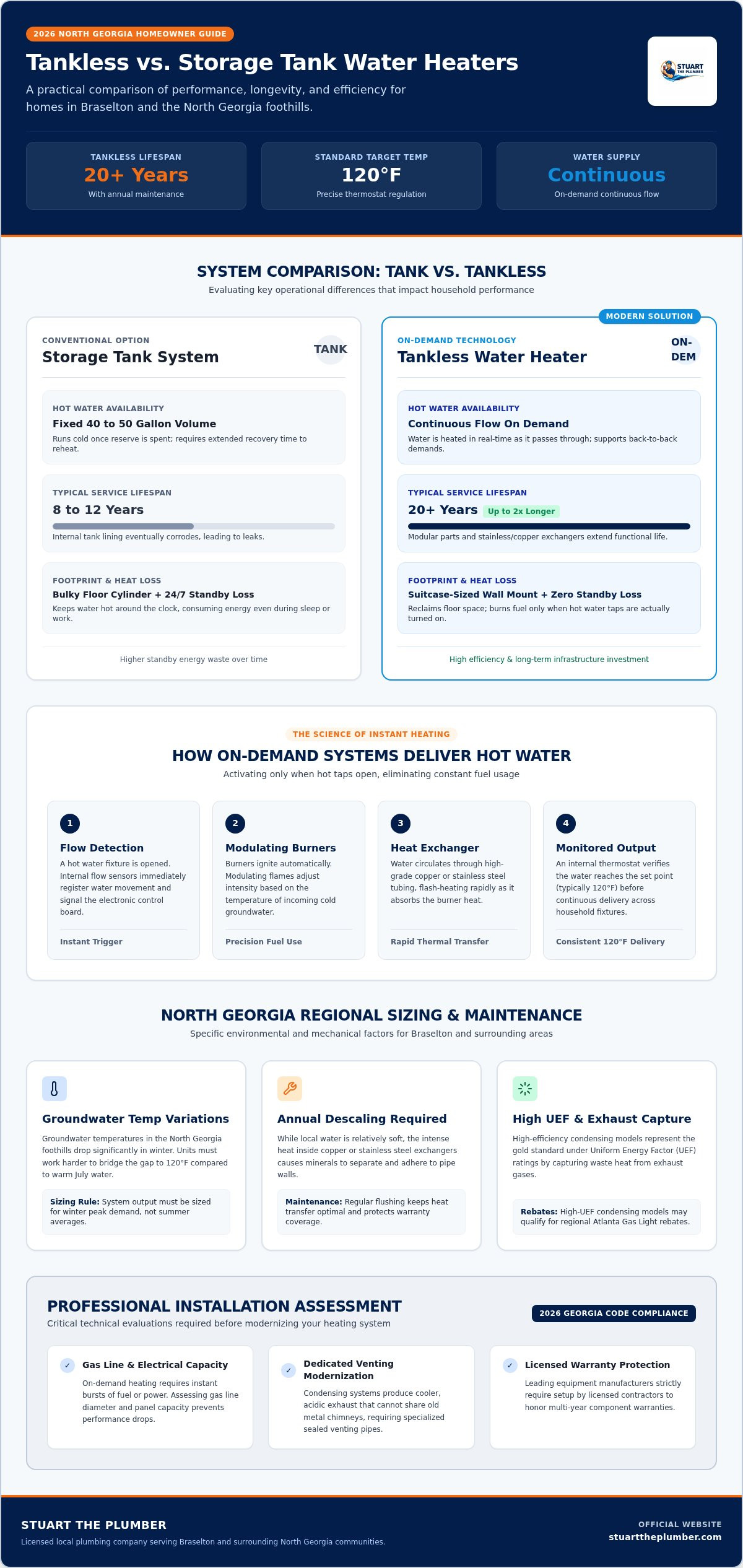
Traditional water heaters keep 40 to 50 gallons of water hot around the clock. This creates standby heat loss, which means you’re paying to heat water even when you’re sleeping or at work. Modern tankless water heating technology changes this by heating water instantly as it passes through a high-efficiency heat exchanger. When considering a tankless water heater installation Georgia homeowners often find these systems are the best way to reclaim floor space in a garage or utility closet. Instead of a bulky metal cylinder, you get a compact, wall-mounted unit that’s about the size of a suitcase.
Performance Comparison: Tank vs. Tankless
The biggest frustration with storage tanks is recovery time. Once the hot water is gone, you’re stuck waiting for the tank to reheat before the next person can shower. Tankless units provide a continuous flow. This is a game changer for larger North Georgia homes with multiple bathrooms. If you have kids taking back-to-back showers while the dishwasher is running, an on-demand system won’t quit on you. You can find more details on choosing the right model for your property in our Braselton Water Heater Installation: 2026 Buying Guide.
Long-Term Value and Durability
A standard storage tank typically lasts 8 to 12 years before the internal lining corrodes and leaks. In contrast, a well-maintained tankless unit can serve your home for 20 years or more. This longevity makes it a smart infrastructure investment for your property. However, North Georgia’s water requires specific care to reach that 20 year mark. While our local water is generally soft, minerals still accumulate in high-heat environments. Stuart the Plumber, LLC recommends annual descaling to keep the heat exchanger clear and efficient.
Using a licensed plumber for your tankless water heater installation Georgia project is also vital for your manufacturer warranty. Most major brands require professional setup by a licensed contractor to honor their long-term protection plans. Our team at Stuart the Plumber, LLC focuses on reliable, transparent service to ensure your new system is sized correctly and installed to meet all 2026 state plumbing amendments. This professional approach protects your investment and ensures your family has the hot water they need for years to come.
How Tankless Water Heaters Work: The Science of On-Demand Hot Water
The process begins the moment you turn on a hot water tap. A flow sensor inside the unit detects the water movement and signals the control board to start the heating sequence. Unlike a tank that keeps water hot just in case, this system only activates when there’s a real demand. Modulating burners then ignite, adjusting their flame intensity based on the temperature of the incoming cold water. This is especially important for a tankless water heater installation Georgia homeowners choose, as our winter groundwater temperatures require the unit to work harder than it would in a tropical climate.
A thermostat monitors the outgoing water to ensure it hits your desired setting, usually 120°F. If the incoming water is warmer in July, the burners throttle down to save energy. This precision is part of why the Georgia Consumer Protection Division advisory on tankless water heaters suggests homeowners evaluate their specific utility capacity before upgrading. To ensure your home’s gas or electrical lines can handle this demand, you can reach out to our team at Stuart the Plumber, LLC for a local perspective.
The Role of the Heat Exchanger
A heat exchanger is the core component that flash-heats water without a storage tank. Made of high-quality copper or stainless steel, this part transfers heat from the burners to the water as it flows through narrow pipes. Scale buildup remains the primary threat to this component in North Georgia. Even though Braselton water is relatively soft, the intense heat inside the exchanger causes minerals to separate and stick to the metal. Over time, this scale reduces efficiency and can lead to premature failure if the system isn’t flushed regularly. If you notice fluctuating temperatures or error codes appearing on your unit’s display, understanding the causes behind these symptoms is essential — our guide to tankless water heater repair North Georgia homeowners rely on covers the most common heat exchanger issues and how to address them.
Energy Efficiency Ratings (UEF and EF)
When comparing models, look for the Uniform Energy Factor (UEF). This rating tells you how much of the energy used actually goes into heating your water. Condensing units are the gold standard for efficiency because they capture heat from exhaust gases that would otherwise be wasted. When planning a tankless water heater installation Georgia project, choosing between condensing and non-condensing models is a key decision. Because condensing units are so efficient, the exhaust is cool enough to vent through plastic pipes, but they do produce acidic condensation. Stuart the Plumber, LLC ensures this liquid is safely neutralized and drained according to local standards.
The Professional Installation Process: What to Expect
A tankless water heater installation Georgia project is more complex than a standard tank swap. You aren’t just replacing a machine; you’re upgrading your home’s infrastructure. Because on-demand units generate high heat instantly, they require significantly more fuel and different venting than old storage tanks. Stuart The Plumber starts every project with a thorough site assessment to ensure your home can support the high performance of a modern system. We don’t just hang a box on the wall; we ensure the entire system works safely within your home’s existing footprint.
Assessing Your Home’s Utilities
Most traditional tanks run on a 1/2-inch gas line. However, a whole-home tankless unit typically requires 150,000 to 199,000 BTU/h to provide a 65 degree temperature rise during a North Georgia winter. This often means we must upsize your gas line to 3/4-inch or 1-inch to meet 2026 Georgia State Amendments for fuel gas codes. We also evaluate your electrical setup. Even gas-powered units need a dedicated circuit for the digital control board and flow sensors. If you’re wondering about the schedule, our guide on How Long Does It Take to Replace a Water Heater? explains what to expect during the transition.
The Step-by-Step Installation Timeline
On the day of service, our team arrives ready to handle the heavy lifting. We focus on protecting your property while modernizing your utility space. The process generally follows these steps:
- Step 1: Removal: We safely drain, disconnect, and haul away your old storage tank for proper disposal.
- Step 2: Mounting and Venting: We mount the compact unit to the wall. We then install specialized Category IV PVC or polypropylene venting to handle the cooler, acidic exhaust from condensing models.
- Step 3: Connections: Our plumbers connect the new upsized gas lines and water pipes using high-quality fittings and precision soldering or pressing.
- Step 4: Testing: We perform a rigorous leak check and verify the flow rate before walking you through the system’s operation and maintenance needs.
Choosing the Right Tankless System for Your Georgia Household
Selecting the right unit isn’t just about picking a brand from a shelf. It’s about matching the machine’s capabilities to your family’s daily habits. For a successful tankless water heater installation Georgia homeowners must look at their peak usage rather than total tank size. If you have three bathrooms and a high-efficiency washing machine, a small unit won’t keep up when everyone gets ready at once. We help you look at the big picture to ensure you don’t end up with a “cold water sandwich” during your morning routine.
Sizing Based on GPM (Gallons Per Minute)
GPM measures how many gallons of hot water a unit can produce every minute. In a typical 3-bedroom home in Braselton or Buford, you might need 5 to 7 GPM to run two showers and a kitchen sink simultaneously. This calculation depends heavily on the “temperature rise.” In North Georgia, winter groundwater can drop to 55°F. To hit a comfortable 120°F, your unit must be powerful enough to provide a 65°F rise without slowing the flow. A unit that works perfectly in Florida might struggle in a Georgia January if it isn’t sized for our specific climate.
You also need to decide between gas and electric models. Most North Georgia homes favor gas tankless units for whole-home service. Electric models often draw between 80 and 150 amps. This frequently requires an expensive electrical panel upgrade to 200 or 400 amps. Gas units are generally better at meeting high demand during our coldest months without requiring a complete overhaul of your home’s electrical system.
Why Professional Licensing Matters in North Georgia
Cutting corners with a DIY installation is a risk to your safety and your wallet. These systems involve high-pressure gas lines and specialized venting that must meet the 2024 International Plumbing Code and 2026 Georgia State Amendments. An uncertified install can lead to gas leaks, fire hazards, or carbon monoxide issues. It also voids the manufacturer warranty, leaving you unprotected if a part fails. Stuart The Plumber is a licensed local plumbing company serving Braselton and nearby communities. We focus on reliable, transparent service to ensure your system is sized correctly and installed with the integrity your home deserves.
Ready for Endless Hot Water in Your Georgia Home?
Modernizing your home with an on-demand system is a smart investment that pays off in daily comfort and long-term efficiency. You’ve seen how these units reclaim valuable floor space while eliminating the high energy costs of heating a massive storage tank. By choosing a system sized correctly for North Georgia’s winter groundwater temperatures, you ensure your family has the hot water they need even during the coldest months. Professional oversight is the only way to guarantee your new equipment meets local 2026 plumbing codes and maintains its manufacturer warranty.
Stuart The Plumber is a licensed and insured local plumbing company serving Braselton and the surrounding communities. We bring authoritative expertise to every tankless water heater installation Georgia project. Our team understands North Georgia home infrastructure and provides comprehensive services for leaks, repairs, and full system upgrades. Don’t settle for lukewarm showers or high utility bills when a more reliable solution is available right in your neighborhood.
We look forward to helping you modernize your home and providing the peace of mind that comes with professional local service.
Frequently Asked Questions
How much does it cost to install a tankless water heater in Georgia?
Installation costs vary based on the complexity of the venting and whether your gas or electrical infrastructure needs an upgrade. A professional assessment is the only way to determine the specific requirements for your home. Factors like the unit’s efficiency rating and the distance to the exterior wall for venting will influence the total project scope. Stuart The Plumber provides transparent evaluations to help you understand the investment for a tankless water heater installation Georgia project.
Do I need to upgrade my gas line for a tankless water heater?
Most homes require a gas line upgrade to support the high BTU demand of an on-demand system. While a traditional tank might run on a 1/2-inch line, a whole-home tankless unit often needs a 3/4-inch or 1-inch line to function safely. This ensures the unit receives enough fuel to heat water instantly during peak winter demand in North Georgia without starving other gas appliances like your stove or furnace.
How long do tankless water heaters last compared to standard tanks?
Tankless units typically last 15 to 20 years, which is nearly double the lifespan of a traditional storage tank. Standard tanks usually begin to show signs of corrosion or leakage after 8 to 12 years. Because tankless systems don’t store water, they aren’t subject to the same constant internal pressure and sediment buildup that causes conventional tanks to fail. Regular maintenance helps ensure you reach that 20 year potential.
Can a tankless water heater provide enough hot water for a large family?
An appropriately sized tankless system can provide endless hot water for even the largest families. The key is calculating the Gallons Per Minute (GPM) based on how many fixtures you plan to run at once. For a home in Hoschton or Gainesville, we look at the temperature rise needed to heat 55 degree groundwater to 120 degrees. This ensures everyone gets a hot shower even if the dishwasher is running.
What maintenance does a tankless water heater require in North Georgia?
Regular descaling is the most important maintenance task for homeowners in North Georgia. Even though Braselton municipal water is classified as soft, minerals still separate and attach to the heat exchanger over time. We recommend a professional flush every 12 to 18 months to remove this scale. This simple service protects your heat exchanger and keeps the unit running at peak efficiency for its entire lifespan while preventing unexpected breakdowns.
Is it better to get a gas or electric tankless water heater in Braselton?
Gas models are generally more practical for whole-home use in the Braselton area. Electric tankless units draw a massive amount of power, often requiring 80 to 150 amps of dedicated capacity. This usually leads to expensive electrical panel upgrades to 200 or 400 amps. Gas systems are more efficient at providing the high temperature rise needed during Georgia winters and are the preferred choice for most of our local residential infrastructure. If your system ever stops performing as expected, our no hot water troubleshooting guide for Georgia homes can help you identify whether you’re facing a simple fix or need a professional no hot water plumber Georgia families trust for an honest diagnosis.

Article by
Stuart Balestracci
Stuart is a third-generation master plumber dedicated to providing dependable, honest plumbing service throughout Braselton and North Georgia. Building on a family tradition of hands-on trade expertise, he brings practical problem-solving and high standards to every job—from urgent leaks and clogged drains to water heaters, sewer lines, and whole-home repiping.
Stuart believes customers deserve clear answers, quality workmanship, and repairs that address the real issue—not a quick fix that creates another problem later. Through Stuart the Plumber, LLC, he serves homeowners, property managers, and businesses with professional service, straightforward communication, and respect for their property. The company operates as a licensed Georgia plumbing business, license MP208668.
Disclaimer
The information in this article is provided for general educational and informational purposes only. While Sturat the Plumber, LLC makes reasonable efforts to keep information accurate and current, plumbing conditions, building systems, local codes, manufacturer instructions, and repair requirements vary by property and may change over time.
This content is not a substitute for an on-site inspection, diagnosis, estimate, professional plumbing service, or advice from a properly licensed professional. Do not rely on this article to diagnose gas leaks, sewer backups, hidden water leaks, water-heater failures, burst pipes, or other potentially hazardous conditions.
Plumbing work can involve risks including water damage, electrical hazards, gas hazards, sewage exposure, structural damage, and personal injury. Always follow applicable local codes, product instructions, and safety requirements. For active leaks, suspected gas leaks, sewage backups, flooding, loss of water service, or any situation that may create an immediate safety risk, contact a qualified professional or emergency services as appropriate.
Sturat the Plumber, LLC does not guarantee that the information in this article is complete, suitable for every property, or applicable to your specific circumstances. Any decisions or actions taken based on this content are at your own risk. Sturat the Plumber, LLC disclaims liability for loss, damage, injury, expense, or other consequences arising from the use of or reliance on this information.
For an evaluation of your specific plumbing concern, contact Sturat the Plumber, LLC for professional service. Sturat the Plumber, LLC is a licensed Georgia plumbing business, license MP208668.